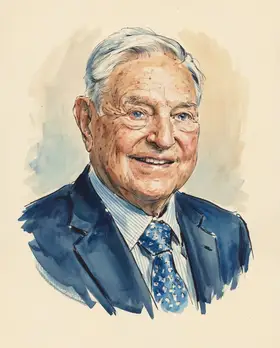
George Soros on Government Policies
TL;DR
George Soros strongly advocates for open, accountable governance, often contrasting it with rising nationalism and closed systems.
Key Points
He strongly supported European Union reform, arguing for a more flexible, multi-track approach to counter nationalism and austerity policies following the 2008 financial crisis.
In 2004, he called on the United States to re-examine its relationship with the Uzbek government after it forced the closure of the Open Society Institute in Tashkent.
He argued in 2018 that the impact of technological innovation on unemployment depends heavily on government policies, praising the Nordic countries for protecting workers, not just jobs.
Summary
George Soros fundamentally champions government policies that support open societies, characterized by critical thinking, accountability, and the rule of law, drawing heavily from the philosophy of Karl Popper. He has actively funded initiatives globally through the Open Society Foundations to defend these democratic achievements against authoritarianism, exemplified by his focus on empowering local people in places like Africa to deal with their own problems. This advocacy leads him to criticize specific government actions, such as the restrictive registration procedures imposed by the Uzbek government on international NGOs, which he argued stifled civil society and violated human rights commitments in 2004.
However, his views and interventions on specific national policies often put him in conflict with ruling parties, leading to intense political scrutiny and accusations of interference. For instance, his critique of the Indian government's policies and its handling of the Adani crisis positioned him as a target of the ruling BJP, which accused him of attempting to destabilize the nation. Furthermore, he has called for stringent regulation and taxation of IT monopolies, arguing their current business models undermine democracy and that governments, like the EU, must step in where US regulators are too weak to act.
Frequently Asked Questions
George Soros's core belief is that government policies should aim to defend and promote open societies. This means fostering accountability, critical thinking, and the rule of law against forces of authoritarianism. He views open societies as essential for societal progress and stability.
Yes, his focus has evolved over time in response to global shifts. While his foundations initially focused on the former Soviet sphere, he stated that more than half their budget is now spent closer to home, addressing threats to open society in the US and Europe.
George Soros argued that giant internet platform companies act as near-monopolies and should be subjected to more stringent regulation and taxation. He believed their business models exploit the social environment and that government action, like that from the EU, is necessary to preserve competition and protect democracy.
Sources8
Remarks delivered at the World Economic Forum
Uzbek Government Forces Closure of Local Soros Foundation
Social Media a Security Threat
How George Soros became 'Enemy Number 1' for India's Modi
Elusive Truths: Why Good Policies Alone Won't Save Democracy
Only the EU can break Facebook and Google's dominance
Soros and Open Society: The Myth of Falsification
Chicago Fed Letter - Global financial crisis and economic development
* This is not an exhaustive list of sources.