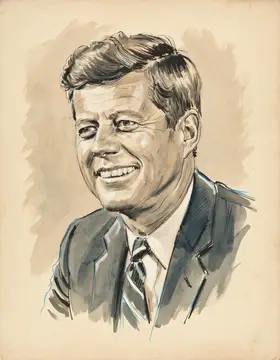
John F. Kennedy
- Known for
- 35th U.S. President, Cuban Missile Crisis, Bay of Pigs
- Born in
- Brookline, United States
- Education
- BA Government, Stanford Graduate School of Business
John F. Kennedy (JFK) served as the 35th U.S. President during the tense height of the Cold War, defining his administration with decisive foreign policy actions. As the youngest elected president and the first Catholic in the office, his brief term ended tragically with his assassination in 1963. His legacy is characterized by idealism, international engagement, and a focus on ambitious national challenges.
Signature Positions
Kennedy's presidency centered on managing global conflict while initiating domestic programs:
- Cold War/Flexible Response: Shifted defense strategy from massive retaliation to flexible response, building nuclear capabilities while seeking deterrence.
- Cuban Missile Crisis: Navigated the world to the brink of nuclear war before securing the removal of Soviet missiles from Cuba via a naval quarantine and a private agreement to remove U.S. missiles from Turkey.
- Space Race: Committed the U.S. to the ambitious goal of landing a man on the Moon before the decade's end to bolster national prestige.
- Civil Rights: Initially cautious due to reliance on Southern Democrats, he eventually escalated federal intervention, culminating in the proposal for the Civil Rights Act of 1964.
- Decolonization: Advocated for supporting self-determination in the Third World, establishing the Peace Corps to counter communist influence through aid.
How Views Have Evolved
Kennedy's stance on Civil Rights evolved significantly during his presidency. Early on, he prioritized legislative victories on his New Frontier agenda and maintained a distant posture, fearing Southern backlash.
This evolved after intense pressure, particularly following the violence against Freedom Riders and the Ole Miss riot. His June 1963 speech, following the confrontation with Governor George Wallace, marked a decisive shift toward federal enforcement and support for equal access.
Notable Tensions
The Kennedy administration presented several ideological and political contradictions:
- Vietnam War: Increased U.S. military advisers significantly from Eisenhower's levels, while simultaneously engaging in Operation Mongoose against Cuba and voicing support for South Vietnamese self-determination.
- Civil Rights vs. Legislation: His support for civil rights legislation often clashed with his political necessity to appease Southern Democrats, leading to perceived slowness on key issues.
- Economic Policy: Pushed a Keynesian tax cut to spur growth, which drew criticism from liberals who felt it shifted focus away from promised social programs like healthcare for the elderly.
Kennedy's presidency is often remembered through the lens of Camelot, representing a perceived 'shining moment' of youthful vigor and idealism in American leadership. His televised debates against Richard Nixon redefined political communication by bringing the medium to the forefront of campaigns. Following his death, many of his stalled domestic proposals, including the Revenue Act of 1964, were successfully enacted by Lyndon B. Johnson.