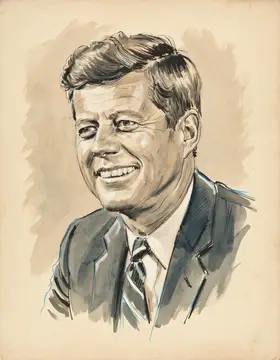
John F. Kennedy on Education
TL;DR
John F. Kennedy viewed education as the essential keystone for national freedom, progress, and security, necessitating robust federal investment.
Key Points
He delivered a Special Message to Congress on Education in January 1963, outlining a comprehensive program to enlarge federal investment in citizen education.
Kennedy stressed that an educated citizen has an obligation to encourage the pursuit of learning and support improvement of education for all Americans, from grade school to graduate school, as stated in 1963.
In his 1961 message to Congress, he recommended a program of state-administered scholarships, initially authorizing 25,000 scholarships averaging $700 each for talented and needy young people.
Summary
John F. Kennedy regarded education as the "keystone in the arch of freedom and progress" for the United States, believing that national strength and opportunity were directly tied to the excellence and availability of schooling at all levels. He argued that failures in the educational system, such as high dropout rates and shortages in scientific manpower, led to failures in the social and economic systems, making improved education a vital matter of national security. The president asserted that the federal government had a responsibility to bolster state and local efforts, emphasizing that federal participation should be selective and stimulative, not controlling.
During his presidency, he proposed comprehensive legislation, such as the National Education Improvement Act of 1963, aimed at achieving a new standard of excellence and maximum access to learning. His proposals spanned the entire educational continuum, from pre-school through graduate studies, including specific plans for improving instruction, expanding college facilities through loans and grants, increasing financial aid via scholarships and work-study programs for needy students, and modernizing vocational education to meet technological demands. He stressed that an educated citizenry was crucial for guiding the nation safely through the Cold War era.
Key Quotes
Liberty without Learning is always in peril and Learning without Liberty is always in vain.
Frequently Asked Questions
John F. Kennedy considered education the foundational element for national freedom and progress, as he stated in his 1963 message to Congress. He believed the nation's strength in the world was directly linked to the quality and accessibility of its schools and colleges. He saw it as a critical investment in human potential and national security.
The president proposed that federal participation in education should be selective, stimulative, and transitional, rather than taking over local responsibility, according to his 1963 message. His proposals included funding for classroom construction, increasing teacher salaries, and expanding financial aid for college students.
Yes, he repeatedly linked educational improvement to national security, especially in the context of the Cold War, as mentioned in his 1961 address. He noted that a capable citizenry was required to match the power of totalitarian systems and demonstrate the superiority of freedom.
Sources8
Special Message to the Congress on Education.
For National Teacher Day, a quote from President Kennedy about the importance of ed...
John F. Kennedy Speeches - Baltimore, MD
Kennedy and Education: With a Foreword by William F. Brade...
John F. Kennedy Quotes About Education | A-Z Quotes
Quote by John F. Kennedy: “If the pursuit of learning is not defended ...
* This is not an exhaustive list of sources.