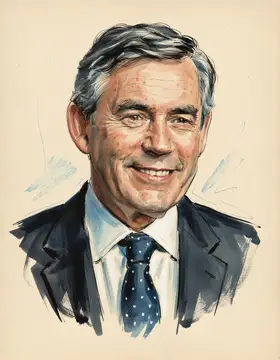
Gordon Brown on Palestine
TL;DR
Gordon Brown advocates for a durable, internationally-agreed two-state solution involving Israeli withdrawal and a shared Jerusalem.
Key Points
In July 2008, he called for Israeli withdrawal from the West Bank as part of a final peace deal, addressing the Israeli Knesset as the first British Prime Minister to do so.
His government revoked export licenses for weapons sold to Israel during the 2009 Operation Cast Lead assault on Gaza.
He dismisses peace gestures that do not constitute real negotiation, emphasizing the need for a concrete final outcome plan.
Summary
Gordon Brown has long promoted a two-state solution as the essential framework for resolving the Israeli-Palestinian conflict, a position he articulated clearly during his tenure as Prime Minister. He famously addressed the Israeli Knesset in July 2008, calling for a final peace deal that included an Israeli withdrawal from the West Bank and the establishment of Jerusalem as the shared capital for both the secure Israeli state and a viable Palestinian state. He views this framework, which was being negotiated in 2007-2008, as the best and most realistic path to durable peace, even in times of intense conflict. He believes that the consequences of failing to achieve such a settlement are too severe for the entire region to bear.
Beyond advocating for the final status issues, Brown has also taken action regarding ongoing conflict. In 2009, during Operation Cast Lead, his government secretly revoked export licenses for weapons destined for Israeli navy missile boats being used in the Gaza assault, reflecting a willingness to impose limitations when international law or humanitarian concerns were perceived to be breached. More recently, he has suggested that current actions in the Middle East indicate a failure by some parties to observe the laws of warfare, stressing the necessity of aid delivery, hostage release, and a return to peace settlement planning. His continued support for a two-state framework aligns with Labour Party principles from his era, which he urges the current party to maintain.
Frequently Asked Questions
Gordon Brown's current position remains strongly centered on the necessity of an internationally agreed two-state solution. He has recently suggested that international law appears to be broken in the Middle East and that leaders must act to secure a ceasefire and facilitate aid to clear the path for peace talks. He insists that a lasting settlement, built on his past efforts, is the only way forward.
Yes, Gordon Brown actively worked towards a two-state solution while serving as Prime Minister. He engaged in intensive discussions with both Israeli and Palestinian leaders to establish parameters for a state of Palestine alongside a secure Israel. He noted that efforts were 'inches away' from a deal by the summer of 2008.
The former Prime Minister suggested that international law regarding the conduct of warfare is not being observed by all parties involved in the Middle East conflict. He insisted that the international community must compel adherence to these laws, particularly to prevent the victimization of innocents and non-combatants.
Sources10
Gordon Brown MP – a case to answer - Scottish Palestine Solidarity Campaign
Former PM Gordon Brown suggests international law is being broken in Middle East | ITV News
In 2008, we were inches from peace in the Middle East. I believe it's still within our grasp
Gordon Brown makes plea for Labour Party to immediately and unequivocally adopt internationally-agreed definition of antisemitism
Withdraw For Peace, Brown Tells Israel - Palestine Chronicle
UN / GORDON BROWN SC VETO | UNifeed
Labour, Israel & Palestine: Lessons from the Blair-Brown Years – Labour Friends of Israel
Gordon Brown discusses worldwide economic troubles | NYU School of Law
Gordon Brown discusses worldwide economic troubles | NYU School of Law
The six British prime ministers who have restricted arms sales to Israel | Middle East Eye
* This is not an exhaustive list of sources.