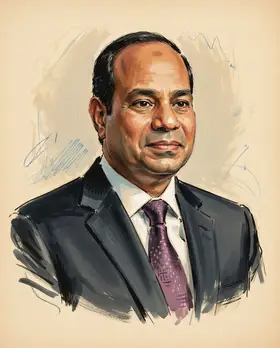
Abdel Fattah el-Sisi
- Known for
- President of Egypt, Led 2013 coup
- Born in
- Cairo, Egypt
- Education
- Thesis, United States Army War College
Abdel Fattah el-Sisi is the 6th President of Egypt, a former military officer who rose to power following the 2013 Egyptian coup d'état. His worldview is centered on national stability, prioritizing state control over democratic pluralism. He leads an authoritarian government, often relying on the military and security services for control.
Signature Positions
Sisi’s tenure has been defined by significant shifts in domestic and foreign policy:
- Governance: Leads an authoritarian regime characterized by a crackdown on dissent and minimal political opposition.
- Human Rights: Accused of widespread abuses, including torture, enforced disappearances, and mass arrests of political opponents, particularly Muslim Brotherhood members.
- Economic Policy: Implemented painful, internationally recommended austerity measures, including significant fuel subsidy cuts, to stabilize the economy.
- Foreign Relations: Pivot away from the US toward closer ties with Russia and continued strategic alignment with Saudi Arabia and the UAE.
- Israel/Palestine: Maintains improved relations with Israel, supporting a two-state solution while criticizing Israeli military actions as collective punishment.
Notable Tensions
Sisi's rule is marked by several contradictions and intense domestic and international scrutiny:
- Democracy vs. Coercion: While his background includes studying democracy, his presidency relies on naked coercion and suppresses political opposition, leading many to label him a dictator.
- Rabaa Massacre: His command during the 2013 dispersal of sit-ins, described by HRW as crimes against humanity, remains a defining, highly controversial element of his rise.
- US Relations: Despite historical tension under Obama, he enjoys praise from Donald Trump while simultaneously facing ongoing human rights concerns from the Biden administration.
- Economic Sacrifice: He demands national sacrifice for economic recovery while significant national projects, like the Suez Canal expansion, are rapidly undertaken.
Sisi’s rise marked a sharp end to Egypt’s brief post-2011 democratic experiment, installing military rule not seen since Mubarak. His government is described by some analysts as "The Sick Man of the Middle East" due to ongoing economic turbulence. His initial popularity, fueled by the demand for order after the 2011 revolution, has eroded amid economic hardship and increased repression.