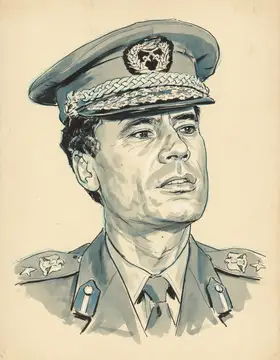
Muammar Gaddafi
- Known for
- Ruling Libya, Third International Theory, Pan-Africanism
- Born in
- Near Sirte, Italian Libya
- Education
- University of Libya
Muammar Gaddafi was the revolutionary leader who ruled Libya for over four decades, seizing power through a 1969 bloodless coup. His worldview was defined by a unique blend of Arab nationalism, Islamic modernism, and his self-authored Third International Theory, articulated in The Green Book.
Signature Positions
Gaddafi's rule was characterized by radical political and economic restructuring, often prioritizing ideology over stability:
- Governance: Established the Jamahiriya ("state of the masses") in 1977, promoting direct democracy through People's Congresses while consolidating personal control.
- Economics: Advocated Islamic socialism, nationalizing the oil industry and redistributing wealth, leading to significant social improvements in healthcare and education.
- Foreign Policy (Early): Fiercely anti-imperialist, expelling Western military bases and supporting global militant groups, including Palestinian factions.
- Foreign Policy (Later): Shifted focus from pan-Arabism to pan-Africanism, positioning Libya as a key player in the African Union.
- Social Issues: Promoted gender equality in certain areas while maintaining a socially conservative stance, particularly regarding women's roles in society.
How Views Have Evolved
Gaddafi's ideology underwent a notable transformation over his rule. Initially a fervent proponent of Arab nationalism and pan-Arab unity modeled after Nasser, he later grew disillusioned with the Arab world. By the late 1990s, he largely abandoned pan-Arabism for pan-Africanism, viewing the continent as the future for revolutionary ideas.
His economic stance also shifted. While early years emphasized state control and nationalization as part of Islamic socialism, the later era saw a turn toward privatization and foreign investment, despite maintaining state control over the vital oil industry.
Notable Tensions
Gaddafi's rule presented numerous internal and external contradictions:
- Democracy vs. Dictatorship: While promoting the Jamahiriya as direct democracy, he operated an authoritarian administration utilizing Revolutionary Committees to suppress dissent and maintain control.
- Anti-Imperialism vs. State Sponsorship: He championed anti-imperialist causes globally but was widely condemned by the West for financing terrorism, including the Lockerbie bombing.
- Islamic Modernism vs. Clerical Opposition: Gaddafi's idiosyncratic interpretation of Islam and his insistence on The Green Book caused clashes with conservative Libyan clerics.
- Social Reform vs. Human Rights: Supporters praise the regime for housing and healthcare, yet critics condemn systemic human rights violations and the persecution of political opponents.
Gaddafi dominated Libyan politics for 42 years, building a pervasive cult of personality that defined the state's identity. His rule was defined by charismatic leadership, using oil revenues to fund ambitious social projects domestically while simultaneously engaging in foreign adventures and backing militant groups internationally.