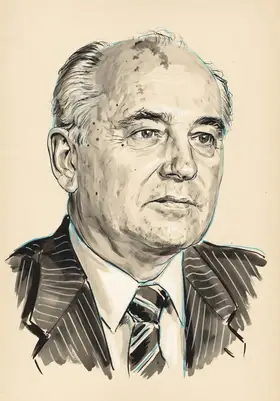
Mikhail Gorbachev on Communism
TL;DR
Mikhail Gorbachev initially sought to reform and save Communism but ultimately moved toward social democracy.
Key Points
His ambition evolved from saving the Soviet Union to destroying the apparatus of the CPSU and defeating Communism in favor of social democracy.
He introduced glasnost and perestroika starting in 1985, which permitted greater freedom of speech and press, undermining the one-party state.
He declined to intervene militarily when the communist regimes of Eastern Europe collapsed in 1989, marking a major departure from Soviet policy.
Summary
Mikhail Gorbachev, as the last leader of the Soviet Union, fundamentally sought to reform the existing Marxist-Leninist system, aiming for a "socialism with a human face." His core policies of perestroika (restructuring) and glasnost (openness) were intended to revitalize the faltering Soviet state, not dismantle it entirely, which he believed was necessary for its survival against internal decay and external pressures. However, by allowing enhanced freedom of speech and press, and implementing nascent democratization measures, he unleashed political and nationalist forces that he could not control, leading to the collapse of the one-party system and the USSR itself.
Over the course of his leadership, Gorbachev’s ideological position shifted from adhering to Marxism-Leninism to effectively embracing social democracy by the early 1990s. He later stated that his ambition evolved to liquidate the communist dictatorship entirely and establish a path of social democracy, finding allies in this goal. Crucially, he refused military intervention to support failing communist regimes in Eastern Europe in 1989, a decisive move that cemented the end of that bloc's adherence to Marxist-Leninist governance. [cite:7, cite:4]
Key Quotes
My ambition was to liquidate communism, the dictatorship over all the people.
Frequently Asked Questions
Mikhail Gorbachev's initial goal upon taking power was to reform the existing Soviet system, aiming for what associates described as 'socialism with a human face.' He introduced perestroika and glasnost to address systemic issues without abandoning the core ideological structure. However, his efforts ultimately led to the dissolution of the Soviet Union rather than its preservation under the old system.
Many critics, particularly hardliners, viewed Gorbachev as having betrayed socialism because his reforms dismantled the one-party rule and allowed for the collapse of the Eastern Bloc. Conversely, he viewed his actions as fulfilling a mission to liquidate the dictatorship and move toward social democracy, which he saw as beneficial for the people. [cite:4, cite:3]
Yes, Mikhail Gorbachev was committed to preserving the Soviet state and its Marxist-Leninist principles at the outset of his tenure. He pursued reforms to make it survive, but the ensuing democratization and nationalist sentiments led to the Soviet Union’s dissolution against his wishes in December 1991.
Sources6
Fall of Communism in Eastern Europe, 1989 - Milestones in the U.S. Foreign Relations
Mikhail Gorbachev - Wikipedia
Mikhail Gorbachev's Undoing Was His Devotion to Soviet Ideas | Victims of Communism Memorial Foundation
'My Ambition was to liquidate Communism' - Revolutionary Democracy
Gorbachev and the Collapse of Communism | History Today
The Collapse of Communism - OER Project
* This is not an exhaustive list of sources.