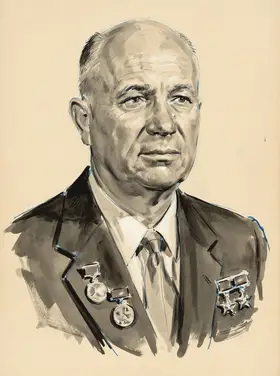
Nikita Khrushchev
- Known for
- Denouncing Stalin, De-Stalinization, Cuban Missile Crisis
- Born in
- Kalinovka, Russia
- Education
- Stalin Industrial Academy
Nikita Khrushchev defined the post-Stalin era, rising from metal worker to the First Secretary of the Communist Party of the Soviet Union (1953–1964). His leadership was characterized by the radical De-Stalinization campaign and tense superpower standoffs during the Cold War.
Signature Positions
Khrushchev's tenure saw dramatic shifts both domestically and internationally:
- Joseph Stalin: Delivered the 'Secret Speech' denouncing Stalin's cult of personality and purges, signaling a less repressive era.
- United States: Pursued a policy of 'Peaceful Coexistence' with the West, despite aggressive rhetoric like 'We will bury you,' culminating in the Cuban Missile Crisis.
- Domestic Policy: Launched major initiatives including the Virgin Lands Campaign for agriculture and mass housing known as khrushchyovka, often meeting mixed results.
- Arts and Culture: Advocated for controlled liberalization, allowing works like One Day in the Life of Ivan Denisovich but fiercely attacking others, such as Boris Pasternak.
How Views Have Evolved
Khrushchev's views evolved significantly from his earlier career. During the Great Purge, he was an active enforcer, approving thousands of arrests. After Stalin's death, he actively worked to dismantle the very system of arbitrary terror he once upheld.
His foreign policy shifted from confrontation to a strategic embrace of détente with the US under John F. Kennedy, though tensions often flared due to crises like the Berlin Wall construction.
Notable Tensions
Khrushchev's leadership was riddled with contradictions that ultimately led to his downfall:
- Liberalization vs. Control: He permitted greater artistic freedom, yet exploded in anger at modern art (the Manege Affair) and violently crushed the Hungarian Uprising.
- Agricultural Failures: His overly ambitious farm reforms, particularly the push for corn (maize) and the dismantling of Machine-Tractor Stations (MTS), led to shortages and price hikes.
- Handling of Crises: While he avoided nuclear war during the Cuban Missile Crisis by secretly agreeing to withdraw Turkish missiles, this perceived concession damaged his standing among hardliners.