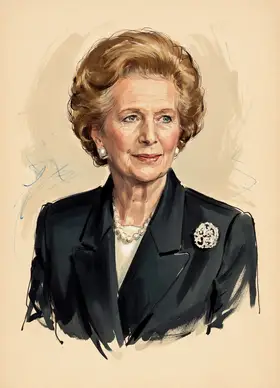
Margaret Thatcher on South Africa
TL;DR
Margaret Thatcher fundamentally opposed international sanctions against apartheid South Africa, favouring constructive engagement and trade for reform.
Key Points
She vocally opposed economic sanctions, stating they would cause poverty, starvation, and destroy the hopes of the very people they intended to help.
In private correspondence with President P.W. Botha in 1985, she stressed that releasing Nelson Mandela would have more impact than almost any single action.
By 1990, following Mandela's release, her government actively lobbied the incoming ANC leadership to adopt open-economy policies to encourage foreign investment.
Summary
Margaret Thatcher's position on South Africa was primarily defined by her staunch opposition to international economic sanctions, which she viewed as punitive and counterproductive to achieving change. She consistently argued that sanctions would only lead to poverty and misery, hurting the black population the most, and favored a policy of 'constructive engagement' with the apartheid government. This stance was rooted in her commitment to free trade principles, leading her to resist pressure from the Commonwealth and other international bodies seeking to impose stronger punitive measures.
Despite her public resistance to sanctions, Thatcher was understood by Pretoria to be a critic of apartheid, which she deemed "economic nonsense." In private, she urged the South African leadership, including President P.W. Botha, to release Nelson Mandela, believing it would be a transformative step. While she initially fought against measures like a sporting contact ban, she eventually acceded to some less stringent sanctions under international pressure. After Mandela's release, her government focused on ensuring the incoming leadership would embrace economic policies attractive to foreign investment, reflecting a pragmatic pivot in approach.
Key Quotes
Britain is fully at one with the rest of the Commonwealth in utterly condemning apartheid and wishing to see its total eradication so that all the inhabitants of South Africa can live in dignity and play a full part in the political life of their country.
Frequently Asked Questions
Margaret Thatcher's main position was a strong opposition to international economic sanctions against the apartheid regime. She believed that trade and 'constructive engagement' were more effective tools for encouraging reform than punitive isolation.
While her anti-sanctions stance led many, including Commonwealth leaders, to view her as a supporter, she opposed apartheid on moral grounds and in private called for Nelson Mandela's release. Her government's position was complex, prioritizing economic stability over comprehensive international measures.
Her fundamental opposition to sanctions remained, but she was eventually obliged to agree to some limited, weakened economic sanctions in 1986 under intense pressure from the US and the Commonwealth. She also actively lobbied for reforms after Mandela's release.
Sources8
How Margaret Thatcher helped end apartheid – despite herself
Thatcher, the Commonwealth and apartheid South Africa
Three lessons for South Africa from Margaret Thatcher's commitment to economic liberty
International sanctions during apartheid - Wikipedia
The Real History of the Crown: Thatcher and Apartheid
Business over apartheid: When Thatcher met Mandela
Written Statement on South Africa (Southern Africa: The Way Ahead, Britain's View)
po123. Tell Mrs Thatcher Stop Supporting Apartheid
* This is not an exhaustive list of sources.