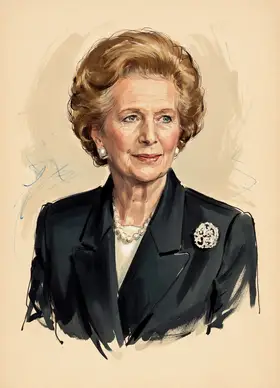
Margaret Thatcher on The European Union
TL;DR
Margaret Thatcher was strongly for European economic cooperation but vehemently opposed a centralized, federal European superstate.
Key Points
She secured a significant, legally binding rebate on Britain's contributions to the European Community budget, finalized after protracted negotiations in 1984.
Thatcher vehemently opposed the move towards a federal Europe, famously stating in her 1988 Bruges speech that Britain had not rolled back the frontiers of the state only to see them re-imposed from Brussels.
She was an enthusiastic promoter of the Single European Act in 1986, which aimed to complete the internal market, but this later concerned her as it expanded the power of European institutions.
Summary
Margaret Thatcher's position on the European Union was characterized by a strong support for continued British membership and practical cooperation, particularly in creating a genuine single market, while being fundamentally opposed to federalism and the centralization of power in Brussels. Her early policy was pragmatic, evidenced by her enthusiastic support for the Single European Act in 1986, which aimed to remove trade barriers, although she later saw this as a catalyst for unwanted political integration. This tension between supporting economic integration and rejecting political union became the defining feature of her European stance.
This growing skepticism towards further centralization culminated in her famous 1988 Bruges speech, which explicitly warned against a European superstate. She believed that loyalty should remain with the nation-state, which she saw as the only legitimate defender of liberty, contrasting with the federalist vision of some European leaders. Her stance favored an intergovernmental approach, where independent states cooperate, rather than a supranational structure that would erode national sovereignty, a position that exposed deep divisions within her own party.
Frequently Asked Questions
Margaret Thatcher's primary objection was against any movement towards a centralized, federal European state that would usurp national sovereignty. She considered the idea of a 'European superstate' a direct threat to the nation-state's role in safeguarding liberty and national identity. She argued that while cooperation was desirable, it should remain intergovernmental rather than supranational.
Yes, Margaret Thatcher supported Britain's fundamental membership in the European Economic Community and campaigned for a 'Yes' vote in the 1975 referendum. Her approach was to be actively involved to reform the Community from within, securing national interests like the budget rebate. She did not want Britain to have a 'cosy, isolated existence on the fringes.'
The 1988 Bruges speech is considered the most trenchant public statement encapsulating her opposition to federal integration, providing a rallying cry for Eurosceptics. In it, she advocated for a 'family of nations' based on voluntary association rather than a single political entity. This address is viewed as highly influential, setting a tone for later Conservative Party skepticism.
Sources5
On Europe: Margaret Thatcher's Lasting Legacy
Bruges speech - Wikipedia
Margaret Thatcher: the critical architect of European integration - UK in a changing Europe
Thatcher Warned Us to Go Slow on European Integration. Too Bad We Didn't Listen
SECTION IV: HISTORICAL ISSUES Margaret Thatcher and the EU
* This is not an exhaustive list of sources.