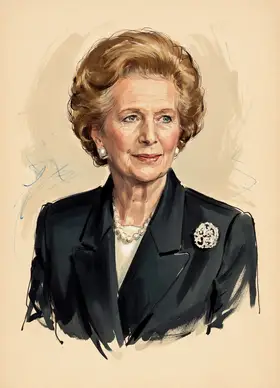
Margaret Thatcher on Europe
TL;DR
Margaret Thatcher supported European economic cooperation but vehemently opposed political federalization, fearing a centralized superstate.
Key Points
She supported the UK’s accession to the European Communities in 1973 and campaigned for a yes vote in the 1975 referendum.
She famously opposed moves towards a federal Europe, articulating this in her 20 September 1988 address to the College of Europe.
Her government secured the UK budget rebate after prolonged negotiations over the Community budget contributions.
Summary
Margaret Thatcher's stance on Europe during her premiership was complex, characterized by support for economic integration tempered by deep skepticism toward political union. She was an enthusiastic proponent of achieving a genuine single market for goods and services, actively supporting the legislative mechanism in the Single European Act (SEA) of 1985 to expedite this goal. However, this pragmatism was often overshadowed by a strident public articulation of the UK’s national interest, most famously demonstrated by her four-year campaign to reduce the UK’s contribution to the Community budget, securing a lasting rebate.
Her position evolved significantly towards opposition to deeper political integration, which she saw as eroding national sovereignty. This growing doubt was encapsulated in her influential 1988 Bruges speech, where she warned against the creation of a European superstate. While she championed free-market principles that inspired emerging economies in Central and Eastern Europe, her conflicts with federalist ambitions, particularly regarding the Exchange Rate Mechanism, deeply divided her government and marked a departure from mainstream European policy, setting a tone for future Conservative Euroscepticism.
Key Quotes
“During my lifetime,” she says, “most of the problems the world has faced have come, in one fashion or other, from mainland Europe, and the solutions from outside it.”
Frequently Asked Questions
Margaret Thatcher was a proponent of European cooperation, particularly for establishing a single market, but she was a vocal opponent of political federalization. She strongly believed that deeper integration risked creating a centralized European superstate that would undermine British sovereignty.
Yes, her position evolved from a mainstream supporter who backed the UK's 1973 entry and the 1975 referendum. As her time in office progressed, she became increasingly skeptical of centralization, culminating in her strong opposition speech in Bruges in 1988.
The 1988 Bruges speech by Margaret Thatcher became a defining moment, serving as a rallying cry for less integration and exposing deep divisions within her party. She warned against a new dominance from Brussels, setting a template for future Euroscepticism.
Sources5
Margaret Thatcher and the Single European Act | Global Policy Journal
On Europe by Margaret Thatcher Book The Fast Free Shipping | eBay
On Europe: Margaret Thatcher's Lasting Legacy | Chatham House – International Affairs Think Tank
Bruges speech - Wikipedia
On Europe by Margaret Thatcher | Goodreads
* This is not an exhaustive list of sources.