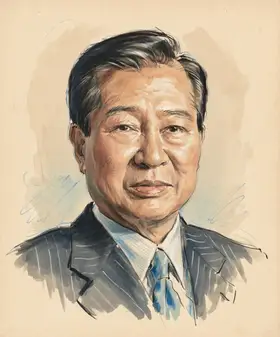
Kim Dae Jung on Park Chung Hee
TL;DR
Kim Dae Jung was a persistent and vocal opponent of Park Chung Hee's military dictatorship, facing severe repression for his democratic efforts.
Key Points
Kim Dae Jung ran against Park Chung Hee in the 1971 election, garnering over 46 percent of the vote despite alleged illegal electioneering.
Following Park's imposition of the Yushin Constitution in 1972, the opposition leader advocated against the extra-legal measures from exile in the US and Japan.
Agents of the Korean Central Intelligence Agency abducted Kim Dae Jung from a Tokyo hotel in August 1973 in an attempt to 'eliminate' him, an attempt that was thwarted.
Kim Dae Jung experienced at least five attempts on his life due to his opposition to the ruling regime led by Park Chung Hee.
Summary
Kim Dae Jung's core position on Park Chung Hee was one of staunch opposition to his military-based dictatorial rule, which began after the May 16 coup d'état in 1961. He firmly established himself as Park's principal opponent during the 1971 presidential election, which he contested advocating for a return to democracy and a welfare-oriented economy, despite the incumbent's heavy-handed tactics. After Park centralized power through the 1972 Yushin Constitution, which allowed for unlimited reelections, Kim Dae Jung lived in exile to advocate against the regime, an activity that led to a dramatic 1973 kidnapping attempt by the Korean Central Intelligence Agency.
This intense conflict framed decades of the opposition leader's career, illustrating the profound division between the two figures in modern Korean history. While Park is remembered for leading rapid economic growth, Kim is recognized as the leading figure who helped free Korea from that dictatorship, leading to sharply divided public evaluations of their legacies. Following Park's assassination in 1979, Kim Dae Jung, after a period of detention and exile under the subsequent military ruler, eventually achieved the presidency, signifying the democratic victory he had long championed against Park's system.
Key Quotes
“If dozens of Soviet divisions were deployed in Baltimore, the U.S. Government could not permit its people to enjoy the same freedoms they do now. If these Soviets dug tunnels and sent commando units into the District of Columbia, then U.S. freedoms would be more limited.”
Frequently Asked Questions
Kim Dae Jung's main contention was with Park Chung Hee's shift to an authoritarian dictatorship, especially after the ratification of the Yushin Constitution in 1972, which concentrated near-absolute power in the president's hands. He consistently advocated for the restoration of democratic rule, which put him in direct opposition to Park's regime.
No, Kim Dae Jung never accepted the results of the February 1971 election, which Park officially won. Many observers believed Kim would have won in a fair contest, establishing him as Park's primary political rival.
After Park Chung Hee was assassinated in October 1979, Kim Dae Jung had his civil and political rights restored briefly before being arrested again by the subsequent military strongman. He was later sentenced to death on charges of treason for his perceived role in inspiring democracy movements.
Sources6
Kim Dae-jung's Role in the Democratization of South Korea
Kim Dae-jung – Biographical
Kim Dae-jung kidnapping: How future Nobel laureate ...
Assassination of Park Chung Hee
93. Editorial Note - Historical Documents - Office of the Historian
How Do You Solve a Problem like (South) Korea?
* This is not an exhaustive list of sources.