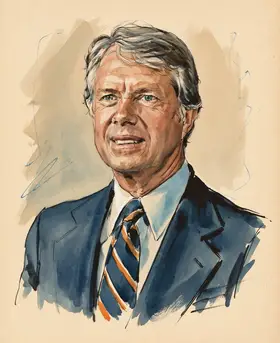
Jimmy Carter on Democracy
TL;DR
Jimmy Carter viewed the advancement and protection of democracy globally and domestically as a moral imperative and core focus of his life's work.
Key Points
As governor in 1971, he stated that the time for racial discrimination was over and demanded equal opportunity in education, jobs, or justice.
He made human rights a cornerstone of his foreign policy as president, including opposing dictatorships in Latin America and the apartheid regime.
In a 2022 opinion piece, he expressed fear that American democracy had become dangerously fragile due to disinformation and political forces seeking power by any means.
Summary
Jimmy Carter's position on Democracy centers on the unwavering belief that free, fair elections and adherence to the rule of law are fundamental to global peace and national security, a principle he championed as president and through his post-presidency work. He integrated human rights as a centerpiece of his foreign policy, explicitly stating that the United States should prefer societies respecting individual human rights. This led to a critical stance against authoritarian regimes, even allied ones, and the active promotion of democratic transitions worldwide, often through election monitoring via The Carter Center.
His commitment was deeply personal, stemming from his own early political experience battling election fraud in Georgia. Later in life, he expressed profound concern over the fragility of American democracy, warning against toxic polarization, disinformation that erodes trust in electoral systems, and partisan legislative efforts to interfere in election processes. He articulated clear demands for upholding democratic norms, including good-faith adjudication of disputes, protecting election officials, and resisting divisive political forces, seeing the fate of domestic democracy as a critical test for the nation.
Key Quotes
I will continue to travel this country, to hear the people of America.
Frequently Asked Questions
Jimmy Carter has consistently maintained a strong, positive position on democracy, viewing it as inextricably linked to human rights and peace, according to tributes following his passing. He saw its protection as both a foreign policy objective and a domestic necessity. His entire post-presidency career has been dedicated to actively supporting democratic norms, as noted by organizations monitoring elections globally.
During his presidency, Jimmy Carter reshaped U.S. foreign policy to champion human rights, leading to a critical stance toward authoritarian regimes globally. His administration reduced military aid to dictatorships in places like Chile and Argentina citing human rights violations. He also successfully mediated the Camp David Accords, demonstrating his belief in negotiation under democratic principles.
Yes, in a 2022 New York Times op-ed, Jimmy Carter voiced significant fear for the state of American democracy, citing disinformation and partisan efforts to undermine election integrity. He warned that the nation risked civil conflict and the loss of its democratic system without immediate collective action.
Sources9
In His Own Words
In His Own Words: Carter Had Fear For Our Democracy
Jimmy Carter: I Fear for Our Democracy
Lessons for Democracy Reformers in the Legacy of President Jimmy Carter
JIMMY CARTER, “CRISIS OF CONFIDENCE” (15 JULY 1979)
The Promise and Peril of Democracy (Full Text of Speech)
Honoring the Legacy of President Jimmy Carter
Honoring Jimmy Carter: Former president was champion for human rights and democracy
President Jimmy Carter Remembered As Defender of Democracy
* This is not an exhaustive list of sources.