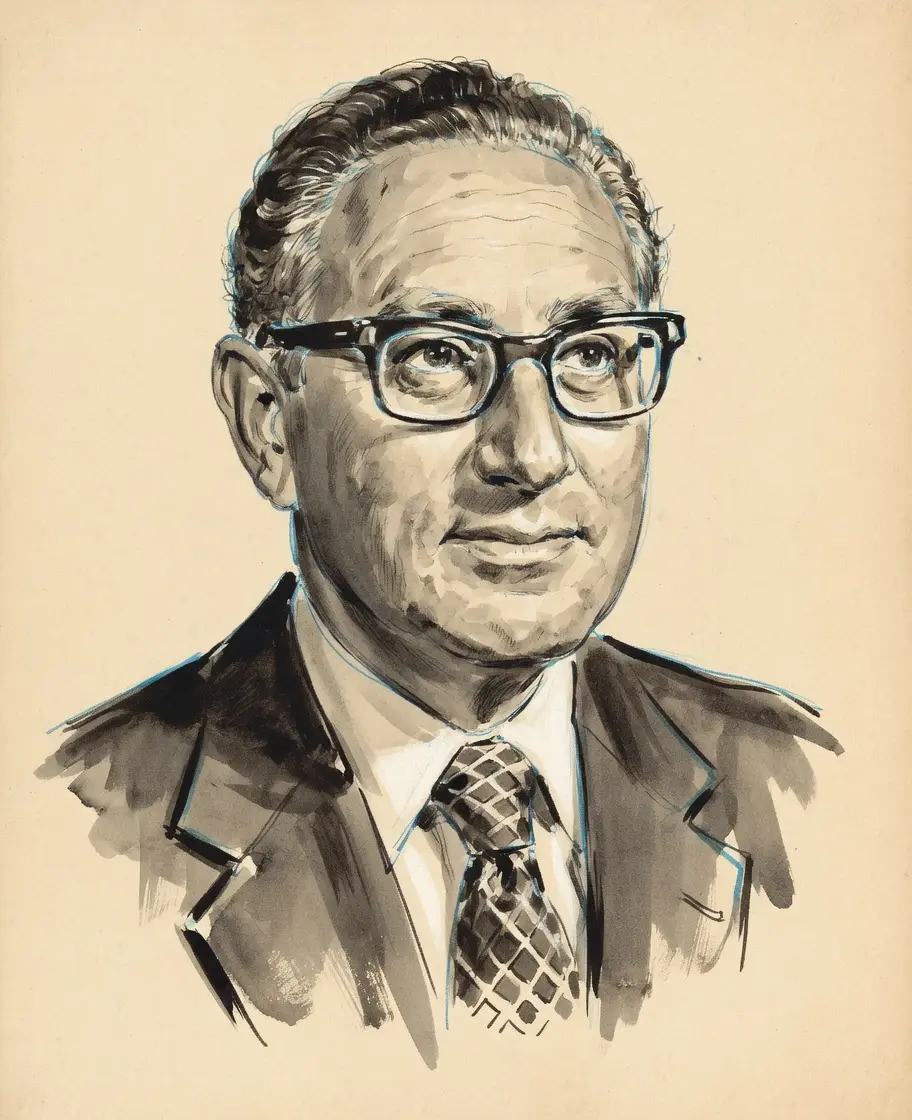
Henry Kissinger on China
TL;DR
Henry Kissinger views China through a historical and cultural lens, advocating for pragmatic co-evolution rather than confrontation.
Key Points
His secret 1971 trip to Beijing laid the groundwork for President Nixon's historic recognition of the People's Republic of China.
He contrasts the American belief in spreading values globally with China's historical view of itself as a cultural 'Middle Kingdom' that rarely sought to proselytize.
Kissinger advises balancing American moral convictions on issues like human rights with the practical requirements of national security in foreign policy.
Summary
Henry Kissinger's position on China, primarily articulated in his book On China, is rooted in a deep historical analysis of Chinese statecraft and culture. He posits that China's worldview is shaped by a millennium of operating as the 'Middle Kingdom,' leading to a cyclical view of history, a preference for subtlety and patience in strategy, and a form of exceptionalism based on culture rather than missionary zeal. His experience coordinating the 1971 secret trip and President Nixon's 1972 visit underscores a pragmatic approach, prioritizing geopolitical balance over ideological alignment, which was evident in the strategic necessity of countering the Soviet Union. The analysis covers pivotal moments from the Opium War through the Deng Xiaoping era, aiming to provide Western policymakers with context on the Chinese mindset. [“On China” provides] historical perspective on Chinese foreign affairs from one of the premier statesmen of our time.
The core implication of his analysis is that the Sino-American relationship should be managed as a process of 'co-evolution,' where both nations pursue domestic imperatives while adjusting relations to minimize conflict. This contrasts sharply with attempts to organize Asia based on ideological containment, which he believes would fail due to China's indispensability to its neighbors. Kissinger explicitly balances long-term moral convictions, like promoting democracy, with case-to-case adaptations required for national security, a Realist principle he applies to the need for sustained dialogue. He offers a cautiously optimistic view for the future, suggesting that understanding China's historical rhythm is the key to avoiding a potential conflict analogous to the pre-World War I era.
Key Quotes
"The empire, long divided, must unite; long united, must divide. Thus it has ever been."
Frequently Asked Questions
Henry Kissinger's main thesis, detailed in his book, is that Chinese statesmanship is best understood through its millennia-long history, leading to a distinct worldview. He argues that this historical context fosters a strategic preference for patience, subtlety, and achieving relative advantage over direct, decisive confrontation.
Kissinger played an integral and pioneering role in developing the relationship between the United States and the People's Republic of China during the Nixon administration. He arranged the secret trip in 1971 that led to President Nixon's 1972 visit, a diplomatic reversal that reshaped Cold War dynamics. He views this as a necessary geopolitical calculation to counter the Soviet Union.
He suggests the relationship should be characterized as 'co-evolution' rather than a partnership or outright rivalry. This involves both countries pursuing their domestic goals while cooperating where interests align and actively adjusting relations to minimize conflict and avoid becoming hostage to worst-case scenarios.
Sources7
Henry Kissinger On China's Past And Future
On China by Henry Kissinger, Paperback | Barnes & Noble®
On China - Wikipedia
On China by Henry Kissinger | Goodreads
On China Audiobook by Henry Kissinger - Audible
On China-Reading Guide: On China-Reading Guide
Is "On China" by Henry Kissinger a relevant read in 2022? : r/WarCollege
* This is not an exhaustive list of sources.