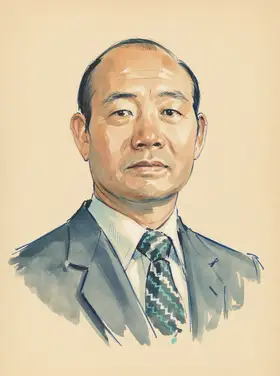
Chun Doo Hwan on Government Policies
TL;DR
Chun Doo Hwan's government implemented policies that favored large conglomerates while suppressing broad political opposition.
Key Points
The regime lacked political legitimacy due to the December 1979 coup and the suppression of the Gwangju Uprising in May 1980.
The Monopoly Regulation and Fair Trade Law in April 1981 was a decisive policy measure aimed at restraining the concentration of economic power in chaebol groups.
Chun Doo Hwan resisted calls for political opening, suspending negotiations for constitutional revision in April 1987, which escalated protests leading to democratic reforms.
Summary
Chun Doo Hwan's government, which oversaw the Fifth Republic of Korea from 1981 to 1988, established its policy framework around consolidating authoritarian military control while pursuing economic liberalization. A key element of his economic policy was an anti-chaebol campaign initiated in the early 1980s, marking a shift away from the previous regime's close ties to big business, ostensibly to curb power concentration and secure popular support after taking power via a coup. This period also involved the privatization of commercial banks between 1981 and 1983, which inadvertently increased the financial autonomy of the large business groups by providing them with diversified funding sources beyond direct government control.
However, the regime's overall posture on governance was highly repressive toward dissent, using measures like the national security law to control activists, including students, who challenged the government's legitimacy and policies. While the government introduced policies aimed at economic reform and liberalization, its actions regarding political participation were characterized by resistance to opening the system, such as when Chun suspended talks for constitutional revision in April 1987. This combination of economic policy shifts and severe political control defined the government's approach until the transition to the Sixth Republic in 1988.
Frequently Asked Questions
Chun Doo Hwan's government pursued a path of economic liberalization, partially through anti-chaebol measures like the Monopoly Regulation and Fair Trade Law of 1981. However, this drive coincided with financial liberalization which ultimately increased the autonomy of large conglomerates by privatizing banks.
Chun Doo Hwan governed with an authoritarian military dictatorship and maintained tight control over dissent. His regime was marked by harsh crackdowns on opposition movements, including the violent suppression of the Gwangju Uprising.
Chun Doo Hwan's decision in April 1987 to suspend talks aimed at constitutional reform, maintaining that the next presidential election would remain indirect, led to dramatic political escalation. This resistance ultimately forced him to accede to demands for direct presidential elections.
Sources8
Fifth Republic of Korea
The Minjung movement and its impact on Korean society
Roots of the Economic Crisis in Post-Democratization Korea
The Consolidation of Democracy in South Korea and ...
SOUTH KOREA: WARNING SIGNS OF POLITICAL CHANGE
The Korean Journal of International Studies
Freedom in the World 2010 - South Korea
* This is not an exhaustive list of sources.