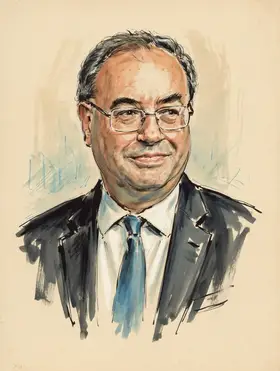
Andrew Bailey
- Known for
- Governor of Bank of England, Central banker
- Education
- Ph.D., University of Cambridge
Andrew Bailey is a veteran British central banker and the current Governor of the Bank of England since March 2020. He is viewed as a safe pair of hands and an experienced technocrat who has navigated significant economic turbulence, including the cost-of-living crisis and the aftermath of the 2008 crisis.
Signature Positions
Bailey's career spans leadership roles across the UK's main financial regulators. His key stances and actions include:
- Inflation: Committed to meeting the 2% target, stating the Bank of England "will not hesitate" to raise interest rates following market volatility.
- Financial Stability: Warned against weakening regulations to spur growth, asserting there is "no trade-off" between stability and growth.
- Bank of England Culture: Objected to the term 'addiction' in a report title regarding Quantitative Easing, citing its damaging connotations.
- Regulatory Oversight: Faced significant criticism regarding the FCA's supervision of London Capital & Finance (LCF) and the British Steel Pension Scheme (BSPS).
Notable Tensions
Bailey's tenure has been marked by several high-profile controversies:
- FCA Oversight: The Gloster Report detailed significant flaws under his FCA leadership, allowing high-risk products to be marketed, leading to major investor losses.
- Personal Responsibility: He actively sought to remove references to his personal responsibility from the Gloster Report, leading to public disagreement with the author, Dame Elizabeth Gloster.
- Worker Pay: Drew criticism from union leaders for advising workers not to demand pay rises during the cost-of-living crisis, while his own salary of approximately £500,000 was disclosed.
- Politicisation: Recent controversy arose over an internship program that appeared to exclude white applicants, leading to accusations of politicising the Bank of England.
Bailey's background is rooted in historical research, holding a Ph.D. from Cambridge where he was active in the Fabian Society, contrasting with his later role as a chief financial regulator. He is seen as the successor who brought institutional knowledge back to the Bank of England after previous leadership, leading to his appointment by Chancellor Sajid Javid.