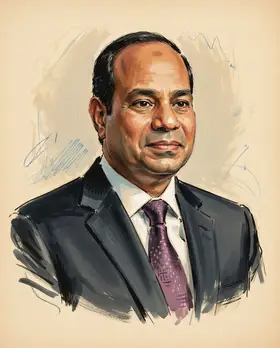
Abdel Fattah el-Sisi on Political Ideology
TL;DR
Abdel Fattah el-Sisi prioritizes state security and stability over liberal democratic principles, often emphasizing state control.
Key Points
He has outlawed the Muslim Brotherhood, labeling the organization a terrorist group following his ascent to power in 2013.
The current administration views military rule as essential to navigating complex security realities, contrasting with imported Western democratic models.
Protests against his rule in September 2020 featured demonstrators chanting slogans such as 'Sisi is the enemy of God.'
Summary
Abdel Fattah el-Sisi's political ideology centers on a strong, centralized state guided by national security imperatives, a position solidified following the 2013 military intervention that removed the previous government. His administration views the military's role as paramount in ensuring stability and preventing a return to the political fragmentation experienced after the 2011 uprisings. This approach often leads to the suppression of ideologically opposed groups, most notably the Muslim Brotherhood, which the current regime has labeled a terrorist organization, viewing it as an existential threat to the state structure. The prioritization of order is often justified as necessary given the complex social and security realities in Egypt and the wider region, contrasting with Western-centric models of democracy which are sometimes viewed as inappropriate or destabilizing for the nation's context.
This ideological stance is further contextualized by the historical struggle against what is termed political Islam beyond just Islamist parties. The government has engaged in state-building that involves the politicization of Islam within the state apparatus, a common practice in many regional nations, but one that is managed under strict government control. The rejection of pluralistic political competition, particularly from Islamist alternatives, suggests a belief that only a system rooted in security and state dominance can prevent a descent into internal conflict or societal fracture, evidenced by crackdowns on dissent following protests against his rule.
Key Quotes
I hope we can build upon it to reach lasting solutions to outstanding disputes
...the war in Gaza is about starvation, genocide and the liquidation of the Palestinian cause
...Egyptian President Abdel Fattah al-Sisi has issued his strongest condemnation yet
Frequently Asked Questions
Abdel Fattah el-Sisi's core political ideology prioritizes state security, stability, and strong centralized rule above liberal democratic pluralism. He views the military as the primary guarantor against ideological threats and political disorder following the 2011 period of unrest.
The President views political Islam, particularly the Muslim Brotherhood, as a fundamental threat to the Egyptian state's stability. He has taken severe measures, including labeling the group terrorist, to suppress its political and social influence across the country.
Yes, his rule has faced significant criticism, particularly regarding human rights abuses, such as the systematic torture of political prisoners and extrajudicial killings. Protests against his regime have included direct calls for him to step down.
Sources7
President Sisi: 🗣 The war in Gaza is about starvation ...
Yale political scientist investigates fallout from the Arab Spring | YaleNews
The War of Security Narratives in Egypt - Mümin Ahmedoğlu
Turkey and Egypt bury the hatchet, marking an end to emerging third axis in the Middle East
Egypt and the Middle East: Democracy, Anti-Democracy and Pragmatic Faith
Why the Muslim Brotherhood Will Not Die
'Sisi is the enemy of God,' chants on Egypt's fourth day of protests against his rule – Middle East Monitor
* This is not an exhaustive list of sources.