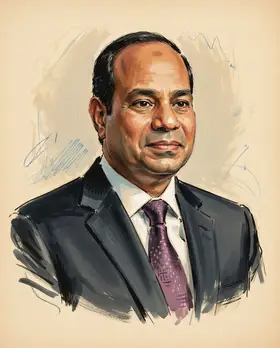
Abdel Fattah el-Sisi on Democracy
TL;DR
Abdel Fattah el-Sisi views democracy as a facade, prioritizing authoritarian stability, state capitalism, and military guardianship over genuine political contestation.
Key Points
Constitutional amendments in 2019 were passed allowing the president to serve an additional term beyond 2030.
The government has systematically restricted civil society, with a 2019 law on civic activity requiring Ministry of Interior approval for foreign funding.
Elections are engineered to ensure loyalists dominate, such as the pro-regime coalition winning 175 of 200 contested Senate seats in the August 2025 polls.
Summary
Abdel Fattah el-Sisi's position centers on establishing a "Second Republic" defined by hyperpresidential powers and military guardianship, actively dismantling the arena for autonomous political contestation, which he views as the cause of past turmoil. The process involves fundamentally undermining party politics, using controlled elections to project an appearance of process rather than genuine competition, and reducing the legislature to a rubber-stamping body. Key evidence of this stance is the systematic repression of civil society and severe restrictions on political rights, including freedom of expression and assembly, leading analysts to classify the system as an electoral autocracy with few democratic elements.
This consolidation extends beyond the political sphere as he seeks to enforce a new social contract based on an ethos of "nothing for free," replacing welfare with an emphasis on work and sacrifice, and cementing a form of state capitalism dominated by the military apparatus. The regime reinforces its authority through pervasive media control and ideological domination, often framing dissent as part of a conspiracy against the state. While Sisi has claimed his republic is built on modernity and democracy, the practical implementation involves concentrating decision-making power, weakening independent institutions like the judiciary, and ensuring the security agencies enjoy formidable impunity.
Frequently Asked Questions
Abdel Fattah el-Sisi's position is centered on prioritizing state security and stability over liberal democratic norms. He frames his rule as necessary to protect the country from chaos and is building what he terms a "new republic" based on military guardianship. This approach involves suppressing political opposition and severely restricting civil liberties.
The overall direction has been toward increased authoritarian consolidation since assuming the presidency in 2014. While he initially promised a civilian-controlled country, his administration has since systematically weakened checks and balances and constrained political participation. The core of his rule remains highly centralized and security-focused.
The president has argued that his republic is built on the foundations of modernity and democracy, though observers note that the electoral process is tightly controlled. He has asserted that his high vote percentages in elections demonstrate popular legitimacy, while analysts suggest the lack of serious challengers makes elections less about competition and more about projecting support.
Sources10
Egyptian Democracy Is What Sisi Makes of It
Sisi: The Man Who Would Be Pharaoh
The Second Republic: Remaking Egypt Under Abdel-Fattah el-Sisi
Sisi
El-Sisi's First Year as President: Legitimacy, Democracy, and Relations with Israel
Egypt: more than a decade in power and increasingly authoritarian rule
Struggles and Progress: Can Egypt Achieve a Lasting Democracy?
Democracy and Authoritarianism in Egypt Today
Why Democracy in Egypt Still Matters
Al-Sisi's Western Benefactors Are Betraying Egypt's Democratic Struggle
* This is not an exhaustive list of sources.