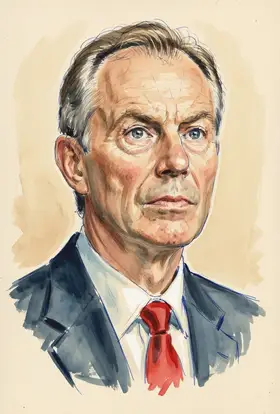
Tony Blair on EU
TL;DR
Tony Blair champions a modernized, liberalized European Union that embraces globalization while maintaining social cohesion and international influence.
Key Points
In 2005, he advocated for a common EU energy policy, a modernized social model, and a focus on research and development to compete globally.
His government chose not to adopt transitional controls on Eastern European EU nationals joining in 2004, despite internal concerns about public service pressure.
He has stated that a key focus for the EU should be controlling migration while also leveraging controlled migration to benefit European economies.
Summary
Tony Blair has consistently maintained a strong, positive stance on the potential of the European Union as a political project, viewing it as essential for improving the lives of its citizens and maximizing international stature. During his time as Prime Minister, he was a passionate pro-European, emphasizing that ideals survive through change and attacking the rhetoric that positioned Britain as having devastated its people through capitalism. He believed economic vitality was inseparable from international clout, supporting treaties and policies like the European Defence Policy, though he shunned the Euro to maintain flexible economic policies.
His post-premiership position advocates for the EU to reform or risk irrelevance in the face of global challenges, stressing modernization over inertia. He has highlighted the need for the EU to address issues like globalization, security, and managing migration while ensuring its social model is modern and competitive. Furthermore, he has been involved in discussions concerning the future of EU-UK relations, supporting frameworks that encourage cooperation, such as the European Political Community, while acknowledging that the UK will not rejoin the bloc.
Key Quotes
"We do not want to destroy social solidarity but to make it relevant to today's world."
Frequently Asked Questions
Tony Blair remains a strong advocate for the European Union but believes it must undergo significant modernization to remain relevant globally. He supports the EU's political project but emphasizes the necessity of adapting its policies to meet modern challenges like globalization.
As Prime Minister, Tony Blair's government decided not to impose transitional controls when ten Eastern European countries joined the EU in 2004. This decision was controversial internally, with some senior figures urging a delay due to anticipated pressures on public services.
Yes, his stance has evolved from a strong proponent of EU integration during his premiership to focusing more on the need for deep structural reform within the bloc. He now champions modernization and liberalization to ensure the EU can compete effectively on the world stage.
Sources6
Senior Labour figures urged Tony Blair to delay arrival of EU citizens in UK
Tony Blair is wrong yet again: Immigration from the EU post-Brexit can and will be controlled
Blair's Vision for Europe: Economic Modernization Can Save our Societies
Tony Blair tells MEPs how Europe should face up to globalisation
A Fresh Start for EU-UK Relations? It's as Easy as EPC
EU must reform or risk irrelevance, Blair, Dimon say
* This is not an exhaustive list of sources.