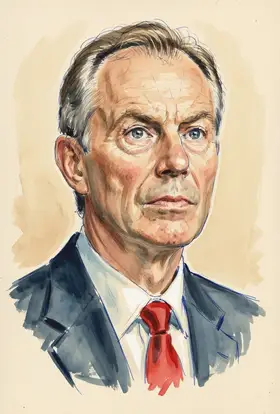
Tony Blair on Climate Change
TL;DR
Tony Blair advocates for a pragmatic climate 'reset' that prioritizes scaling disruptive technologies over consumption reduction.
Key Points
He helped introduce legislation to tackle climate change during his time as Prime Minister (1997-2007).
He argues in a 2025 report that current net-zero policies are unaffordable or politically toxic and require a strategic 'reset'.
His current focus emphasizes scaling carbon capture technologies and investing in breakthrough energy solutions like new nuclear power.
Summary
Tony Blair's current position on Climate Change, often articulated through the Tony Blair Institute for Global Change, calls for a 'reset' of the climate movement, arguing that a focus solely on reducing consumption has become politically toxic and ineffective. He contends that while climate change is a reality and developed world action is vital, the focus must pivot toward making emerging technologies commercially viable to meet the energy demands of developing nations and new technologies like AI. This involves centering climate policy around scaling carbon capture, both at source and through direct air capture, and investing heavily in frontier energy solutions like new nuclear power.
His stance is framed as an evolution from the 'Optimism Era' which was marked by the Stern Review he commissioned, to a new 'Era of Disruption.' He suggests that current net-zero policies are failing to deliver, leading to public skepticism, and advocates for a shift from activist protest to pragmatic policy solutions that unite technologists and policymakers. This approach emphasizes technological innovation, reforming global cooperation to target major emitters like China and India more directly, and rethinking finance, including leveraging philanthropy for high-risk, high-impact innovations.
Frequently Asked Questions
Tony Blair believes that current net-zero policies are politically unachievable and thus require a radical rethinking or 'reset.' He argues that a strategy based on limiting consumption in developed nations is doomed to fail given rising emissions from developing economies. His focus is on technological solutions to drive decarbonization rather than primarily focusing on reducing lifestyle consumption.
He strongly advocates for accelerating and scaling technologies that capture carbon, including both carbon capture and storage (CCS) at the source and direct air capture (DAC). He also champions investment in breakthrough and frontier energy solutions, such as a new generation of small modular reactors (SMRs) and fusion energy, to power future development.
Yes, his position has evolved, moving from an early focus on securing international agreements like the Kyoto Protocol while in office, to his current call for a strategy centered on disruptive technology. He now suggests that previous policy approaches, while important, are no longer working at the necessary speed or maintaining public support.
Sources7
Climate Talks: Tony Blair in Conversation with John Kerry
Why Tony Blair needs to reset his climate reset
Tony Blair and Global Warming
The Climate Paradox: Why We Need to Reset Action on Climate Change
Technology vs Transition?: What Tony Blair gets right - and wrong - about net zero
How 'out of touch' Tony Blair became a serious threat to climate action
* This is not an exhaustive list of sources.