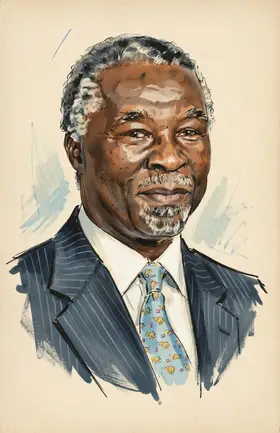
Thabo Mbeki on Leadership
TL;DR
Thabo Mbeki posits that effective leadership demands intellectual rigor, challenging convention, and owning the continent's own intellectual agenda.
Key Points
His presidency was marked by a style that combined intellect and political acumen, daring to question dominant narratives like the HIV/Aids crisis.
He stressed the imperative for Africa to develop its intellectual capital to define its future, calling for the rebuilding of universities and research institutes.
His leadership style was analyzed as sometimes not inclusive, relying on his intellect and overlooking constructive criticism from ministers and stakeholders.
Summary
Thabo Mbeki views leadership as fundamentally intertwined with intellectual capacity and the assertion of an independent, African-centric intellectual agenda. He emphasized that for Africa to define its own future, it must recapture its intellectual space by nurturing its academic cadres, attracting back its intelligentsia, and building strong centers of learning. This stance is deeply rooted in the belief that abdicating intellectual leadership means surrendering the continent's future to external forces who ultimately set the agenda through imported intellectual products.
His leadership style, while internationally acclaimed for its Pan-Africanist vision and focus on global reform, was domestically perceived as technocratic and aloof, sometimes disregarding input from others in favor of his own reasoned inquiry. He believed that true leadership requires the courage to question dominant narratives and challenge conventional wisdom, even when facing criticism, a hallmark demonstrated during his tenure as president. This combination of intellect and conviction forms the core of his philosophy on leading effectively.
Frequently Asked Questions
Thabo Mbeki's core philosophy centers on intellectual leadership, requiring leaders to possess deep reasoned inquiry and the courage to challenge established orthodoxies. He believed that this intellectual independence is crucial for setting a domestic and continental agenda, rather than consuming intellectual products set by others.
Critics often described Thabo Mbeki's political leadership style as overly distant, aloof, and technocratic, especially during his time as president. This was sometimes seen as a result of his reliance on his own intellect and a perceived exclusion of input from cabinet ministers and other stakeholders.
He strongly advocated for nurturing Africa's intellectual cadre as a necessary precondition for the continent to claim the 21st century. He called for sustained support for universities and research centers to ensure African-centered solutions to African problems.
Sources4
Thabo Mbeki on Africa's Intellectual Leadership | African Arguments
Thabo Mbeki: An intellectual powerhouse far ahead of his generation
Thabo Mbeki's African agenda : political leadership style and ideas for global reform
Thabo Mbeki's Leadership Analysis - 1214 Words | Bartleby
* This is not an exhaustive list of sources.