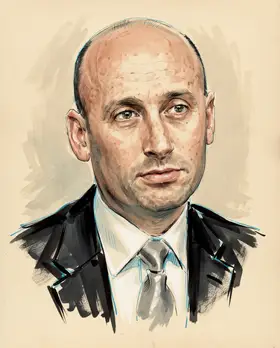
Stephen Miller on Democracy
TL;DR
Stephen Miller's focus on executive power and restricting the franchise suggests a skepticism towards broad democratic processes.
Key Points
He asserted during a CNN interview that the president possesses "plenary authority" regarding the federalization of the National Guard in 2020.
Allies of Stephen Miller have promoted a national “show your papers” rule that critics argue would make voter registration significantly harder for millions.
He was instrumental in promoting the Trump administration's policy to halt the issuance of new green cards in April 2020.
Summary
Stephen Miller's public record indicates a strong emphasis on expansive executive authority, often framed in the context of national security and border control, which critics view as undermining democratic norms and checks and balances. This viewpoint is evidenced by his past statements asserting that the president possesses nearly absolute power, such as claiming the president has "plenary authority" under federal law regarding the deployment of federal resources. His policy advocacy, particularly during his time as a senior advisor, concentrated on policies that critics argue restrict democratic participation, such as efforts to implement national “show your papers” rules that could impede voter registration for millions of eligible Americans.
This stance on executive power and franchise restriction places his ideology in opposition to conventional democratic frameworks that prioritize institutional constraints and broad suffrage. His involvement in crafting and defending policies like the separation of families at the border, which he defended as a "simple decision," demonstrates a willingness to implement hardline measures with little apparent regard for potential public or institutional opposition. Furthermore, his past associations and communications link him to ideologies that view the current demographic makeup of the nation as a threat, which underpins efforts to reshape who is permitted to participate in the political system.
Key Quotes
“The powers of the president to protect our country are very substantial and will not be questioned.”
“Under Title 10 of the U.S. Code, the president has plenary authority,”
Frequently Asked Questions
Stephen Miller's actions and statements suggest a focus on maximizing executive power and securing the nation's borders, which opponents argue prioritizes centralized authority over traditional democratic constraints. He has strongly advocated for policies that critics contend restrict democratic participation, such as initiatives aimed at making voter registration more difficult. Overall, his approach leans toward an aggressive, unilateral executive vision.
Reports indicate that allies of Stephen Miller have pushed for voter suppression measures, such as national documentation requirements for registration, which critics view as an attempt to limit the electorate. This effort is seen by watchdog groups as a strategy to manipulate electoral outcomes by silencing millions of eligible voters. These actions align with a broader pattern of favoring policies that constrain democratic access.
In a notable interview, Stephen Miller claimed the sitting president held "plenary authority" under federal law, meaning total and absolute power in certain executive contexts. This statement underscored his belief in a very strong executive branch, even when challenged by federal judges or other legal interpretations. He later clarified the statement by citing specific sections of federal law concerning the National Guard.
Sources7
Not accessible
Miller and His Allies Want to Silence Millions of Americans
Not accessible
Not accessible
The Ugly Beast of American Authoritarianism | The Nation
Yes, Stephen Miller Said Trump Had 'Plenary Authority' In A CNN Interview
Stephen Miller - Southern Poverty Law Center
* This is not an exhaustive list of sources.