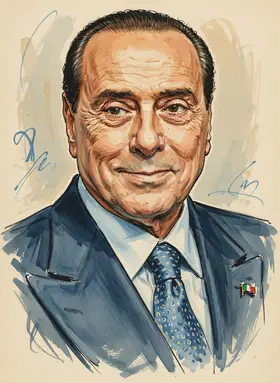
Silvio Berlusconi on Prime Ministership
TL;DR
Silvio Berlusconi viewed the Prime Ministership as a powerful, achievable personal goal that he attained multiple times through media dominance.
Key Points
He served as Prime Minister of Italy across three non-consecutive governments: 1994 to 1995, 2001 to 2006, and 2008 to 2011.
His first government collapsed after only nine months due to internal disagreements within his coalition parties.
He lost his majority and resigned as Prime Minister on 16 November 2011, amid growing fiscal problems related to the European debt crisis.
Summary
Silvio Berlusconi viewed the Prime Ministership as a pinnacle of political power that he successfully attained three separate times, making him the longest-serving post-war prime minister of Italy. His rise to this office was characterized by his unique background as a media tycoon, which he leveraged to win elections, most notably his 1994 entry into politics, described as his "descent on to the field." He utilized his control over a vast media empire to shape public opinion and project a specific image, which was key to his electoral victories, such as in 2001 when he signed the "Contract with the Italians."
His tenure was marked by an ability to consolidate power, often leading to accusations of using the office to protect his business interests and obstruct judicial processes. Even after his final term ended in 2011 amid the debt crisis, Berlusconi maintained an ambition for a comeback, refusing to step aside and preventing clear succession planning for the right-wing coalition. His repeated desire to hold the top office illustrates his view of the role as an extension of his personal dominance in Italian life.
Frequently Asked Questions
Silvio Berlusconi served as the Prime Minister of Italy three times. His terms were from 1994 to 1995, 2001 to 2006, and 2008 to 2011.
Silvio Berlusconi strongly pursued the Prime Ministership, viewing it as a means to consolidate his power and influence across Italian society. He used his media empire to secure this political leadership role repeatedly.
While his first two periods in office ended in collapse or electoral defeat, his desire for the top role remained consistent. Even after his final resignation in 2011, he continued political activity, suggesting an ongoing ambition for a return.
Sources6
Silvio Berlusconi obituary
Silvio Berlusconi - Wikipedia
The rise and rise of Italy's postmodern populist • Inside Story
Italian Right Makes Pact for Prime Ministership – Atlantic Sentinel
Italy: Berlusconi Government Out Of Step With EU Partners
The legacy of Silvio Berlusconi, 1936-2023
* This is not an exhaustive list of sources.