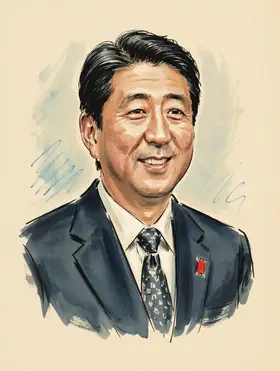
Shinzō Abe on Israel
TL;DR
Shinzō Abe championed a significant warming of Israel-Japan relations, focusing on deep economic and security cooperation.
Key Points
He visited Israel twice as Prime Minister, first in 2015 and again in 2018, to boost bilateral ties.
During his January 2015 meeting, Abe expressed a commitment to proactively contribute to world peace and be a friend of Israel.
His government supported efforts to promote economic development in Palestine, working jointly with Israel and Jordan as part of a regional stability push.
Summary
Shinzō Abe actively sought to elevate Israel-Japan relations, particularly during his second tenure as prime minister, viewing it as a component of his broader proactive foreign policy aimed at strengthening alliances amid concerns over a rising China. This push led to frequent high-level exchanges, including his own visits to Israel in 2015 and 2018, as well as reciprocal visits from the Israeli Prime Minister. The core of this improved relationship was a massive surge in economic ties, characterized by unprecedented Japanese investments in Israel's high-technology sector, moving beyond the previous era where Japan largely acquiesced to Arab League boycotts. Abe's government also initiated dialogues in security and cybersecurity, marking a slight deviation from Japan's historical reluctance to engage in military cooperation with Israel, despite ongoing regional complexities.
The context for this shift involved Japan's desire to secure stability in the Middle East, a region crucial for its energy supply, and to counterbalance other regional powers. Abe explicitly mentioned the importance of maintaining strong relationships across the geopolitical divide, including with Israel, the Arab states, and Iran, while also seeking to contribute to regional stability and the peace process. During his 2015 visit, Abe expressed determination that tragedies like the Holocaust must never be repeated, reconfirming the bonds between the Jewish and Japanese people, and pledged to continue reinforcing Japan’s relationship as a friend of Israel. This engagement included Japanese efforts to promote economic development in Palestine in cooperation with Israel and Jordan.
Key Quotes
Japan will continue our endeavor to reinforce our relationship as a friend of Israel.
My firm belief is that if China is to respect and implement this four-pronged principle, then the whole international community will accept China as a critical partner, and that would eventually enable China's further growth,
Frequently Asked Questions
Shinzō Abe's main focus was strengthening the bilateral relationship through significantly increased economic cooperation, particularly in the high-tech sector, and fostering greater security dialogue. He viewed this partnership as integral to Japan's more proactive foreign policy in the Indo-Pacific region. He made this clear during his visits to Jerusalem.
Yes, during his premiership, Japan moved slightly away from its historical reluctance regarding military ties by establishing dialogues on cybersecurity and signing a memorandum of understanding to strengthen defense cooperation. This was notable as Japan has historically avoided significant military collaboration with Israel. He noted the desire for regional stability.
During his visit, Shinzō Abe toured Yad Vashem and stated his determination that such tragedies as the Holocaust must never be repeated. He linked this commitment to his broader resolve to make a proactive contribution to world peace. He reconfirmed the long-standing bonds between the Jewish and Japanese people.
Sources6
Israel–Japan relations - Wikipedia
Statements by Prime Minister Benjamin Netanyahu and Japanese Prime Minister Shinzō Abe
Former Japanese Prime Minister Shinzō Abe Argues That Stability In The Indo-Pacific Region Depends On Compliance With Rule Of Law
Rivlin to Japanese PM: We are Suffering a Tragedy
Emerging Israel-Japan Relations Since the 2010s - NUS – Middle ...
Japanese Minister of Economy to Visit Israel | Ctech
* This is not an exhaustive list of sources.