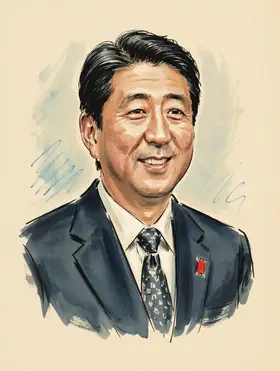
Shinzō Abe on China
TL;DR
Shinzō Abe viewed China as an assertive rival, advocating for strengthening alliances to uphold a rules-based Indo-Pacific order.
Key Points
He initiated the Quadrilateral Security Dialogue (Quad) with the US, Australia, and India, aiming at resisting China's rise as a superpower, starting in 2007.
Abe visited Beijing in October 2006 during his first term to establish a more stable relationship, which was reflected in a Joint Press Statement.
Following a period of tension, he met with President Xi Jinping at the APEC meeting in November 2014 for the first time, suggesting a step toward improved relations.
Summary
Shinzō Abe consistently characterized the People's Republic of China as an increasingly assertive power that challenged the regional status quo, particularly in the East and South China Seas. His foreign and security policy framework, centered on the Free and Open Indo-Pacific (FOIP) vision, was explicitly designed to counterbalance China's military buildup and influence. This strategy involved institutional changes like creating the National Security Council and bolstering Japan’s defense capabilities, alongside deepening security ties with like-minded democracies such as the United States, Australia, and India through frameworks like the Quad.
While promoting a hard-line security posture to deter China, Abe also maintained attempts to manage the bilateral relationship to prevent the trade and investment relationship from collapsing entirely, which led to periods of cautious engagement. He sought a balance, such as meeting with Chinese leadership to establish communication mechanisms like a maritime hotline, while simultaneously working to solidify a network of democracies to ensure regional stability against what he perceived as China's expansionist tendencies. This dual approach reflects a pragmatic effort to manage an intense, long-term strategic competition.
Frequently Asked Questions
Shinzō Abe's strategy was primarily one of strategic competition and external balancing. He aimed to counter China's growing power by strengthening Japan's own defense posture and deepening alliances with other democratic partners in the Indo-Pacific region.
Yes, Abe pursued a dual approach. While advocating for a strong defense posture, he also made personal diplomatic overtures, such as visiting Beijing early in his first term and meeting with President Xi Jinping in 2014, to manage contentious issues and maintain economic ties.
Abe viewed China's actions, especially concerning territorial disputes like the Senkaku/Diaoyu Islands, as attempts to unilaterally impose its model and undermine the established international rule of law. His Free and Open Indo-Pacific vision was a direct response to this perceived challenge.
Sources8
Japan's Foreign Policy: Abe's Legacy
Japan in 2014: Between a China Question and a China Obsession
Li Keqiang Sends Message of Condolence to Prime Minister Shinzō Abe of Japan over the Violent Earthquake in Kumamoto Prefecture of Japan
Shinzo Abe - Wikipedia
Former Japanese Prime Minister Shinzō Abe Argues That Stability In The Indo-Pacific Region Depends On Compliance With Rule Of Law
Li Keqiang Meets with Prime Minister Shinzō Abe of Japan at Request_Ministry of Foreign Affairs of the People's Republic of China
Shinzō Abe and Taiwan-Japan Relations – Taiwan Insight
Japan's New Security Policy: Breaking Away from the Post-War Regime?
* This is not an exhaustive list of sources.