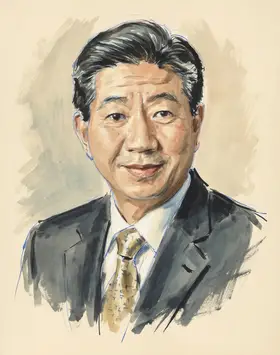
Roh Moo Hyun on Presidential Legacy
TL;DR
Roh Moo Hyun's legacy is defined by high progressive ideals tragically ending amid post-presidency corruption investigations and suicide.
Key Points
He faced the first-ever impeachment of a South Korean president, passing with a 193-2 vote in the National Assembly in 2004.
His impeachment was overturned by the Constitutional Court a month later, leading to a surge in public support for his party.
He was posthumously associated with a corruption scandal involving his family accepting $6 million from a shoe manufacturer prior to his suicide in May 2009.
Summary
Roh Moo Hyun's presidential legacy is characterized by a foundation of high progressive ideals, shaped by his background as a civil rights activist and human rights lawyer, which resonated strongly with the public during his campaign. This idealism was reflected in his attempts to enact diverse political and economic reforms. However, this tenure was marked by significant challenges and controversy, including the first-ever impeachment of a South Korean leader by the National Assembly, which ultimately failed to remove him from office.
His legacy ultimately became deeply intertwined with post-presidency corruption allegations involving family members, which culminated in his tragic suicide in May 2009. While initial public opinion soured due to foreign policy critiques and bribery accusations, public perception often grew fonder posthumously, with many eulogizing his suicide as the ultimate act of principle. Despite the scandal, his high honor orientation, in one analysis, contrasts with low trait self-control and a final association with family corruption absent of direct chaebol involvement, marking his end as a complex political tragedy.
Key Quotes
I agreed with President Moon to turn Korea into a land of peace free of nuclear threats and weapons.
Frequently Asked Questions
Roh Moo Hyun's legacy is complex, defined by his strong commitment to progressive ideals and activism before his presidency. Following his term, his public image became inextricably linked to the corruption allegations that surfaced against his family. Ultimately, his tragic suicide cemented a legacy viewed by many as a form of political martyrdom or sacrifice for his principles.
The impeachment attempt in 2004 served as a dramatic event that initially revealed deep political cleavage but also resulted in a massive public backlash against the establishment in his favor. While the impeachment itself was overturned, the political battles may have provided insight into his dispositional attributes that later factored into his perceived lack of resolve against family malfeasance.
Though public approval reportedly declined before his death due to issues like unpopular foreign policy and bribery accusations, public perception reverted to a more fond view posthumously. Many citizens came to view his suicide as the final demonstration of his commitment to the ideals he championed throughout his career.
Sources2
PRESIDENTIAL SCANDALS IN SOUTH KOREA SINCE 1993: AN ANALYSIS OF RESOLVE IN DECISION-MAKING
A Nation Shaped by Controversy- South Korea's Presidential Legacy
* This is not an exhaustive list of sources.