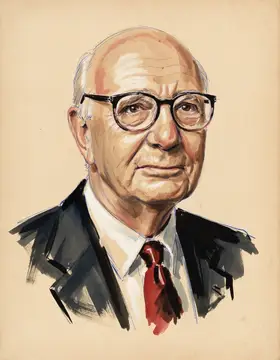
Paul Volcker on Recession
TL;DR
Paul Volcker viewed a recession as a necessary, albeit painful, consequence to decisively break entrenched inflationary expectations.
Key Points
He felt strongly that mounting inflation was the primary concern likely to create the biggest recession in the future.
The 1981-1982 recession was triggered by tight monetary policy, which saw the federal funds rate approach 20 percent.
He maintained a tight policy course in 1982, despite the deepening recession, to ensure that the anti-inflationary momentum was capitalized upon.
Summary
Paul Volcker viewed the threat of recession as a necessary cost for successfully re-establishing the Federal Reserve's credibility in fighting the high, sustained inflation of the 1970s. He believed that failing to contain inflation would ultimately lead to more serious and prolonged economic disruption in the future, arguing that the economy already faced a serious recession without any policy tightening. The aggressive anti-inflation measures he championed, particularly starting in late 1980/early 1981, deliberately led to significantly higher interest rates, which directly triggered the severe 1981-1982 recession, pushing the unemployment rate to a post-World War II peak.
While Volcker personally expressed feeling bad about the job losses, his commitment to price stability superseded short-term economic pain. His predecessors were perceived as having eased policy too soon when unemployment rose, thus demonstrating a lack of commitment that allowed inflation expectations to become embedded. By persevering through the deep downturn, Volcker's Federal Reserve signaled an unwavering focus on long-run price stability, which ultimately paid off as inflation declined significantly and laid the groundwork for a long period of sustained, non-inflationary growth known as the Great Moderation.
Frequently Asked Questions
Paul Volcker accepted that a recession would be a necessary consequence of his aggressive anti-inflation policies. He believed that allowing high inflation to persist would cause more serious and long-term economic damage than the short-term pain of a recession. Ultimately, he prioritized breaking inflation expectations to secure long-term stability.
Yes, Paul Volcker stated that he felt bad about conducting a policy that appeared to throw people out of work. However, he was convinced that a serious recession was already likely due to existing economic distortions caused by inflation. He felt the long-run benefits of price stability justified the short-run economic contraction.
Volcker contended that the cost of failing to curb inflation would be far greater over time than the cost of the disinflationary recession. He viewed the high unemployment during the 1981-1982 downturn as the price required to restore credibility and prevent a perpetual cycle of high inflation and instability.
Sources6
Recession of 1981-82 | Federal Reserve History
Paul Volcker - Wikipedia
The incredible Volcker disinflation
First Measured Century: Interview: Paul Volcker - PBS
Stop Lionizing Paul Volcker and Villainizing Arthur Burns | Cato at Liberty
* This is not an exhaustive list of sources.