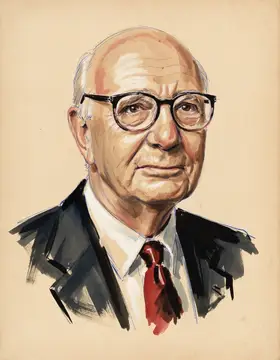
Paul Volcker on Inflation
TL;DR
Paul Volcker believed controlling persistently high inflation required aggressive and sustained restrictive monetary policy, despite causing a severe recession.
Key Points
He announced new anti-inflation measures in October 1979 by shifting the Federal Open Market Committee's focus to managing bank reserves rather than the federal funds rate.
The federal funds rate reached a record high of 20 percent in late 1980 as part of the aggressive measures to contain inflation.
The successful disinflation effort, while ultimately curbing inflation to under 3 percent by 1983, caused the 1981–1982 recession, with unemployment peaking near 11 percent.
Summary
Paul Volcker's core position on inflation, particularly the high rates of the 1970s, was that it constituted a grave threat to economic stability that had to be eradicated, even at significant short-term cost. His evidence was the accelerating, persistent rise in the general price level, which had reached an annual pace of about 9 percent by the time he took office in August 1979. He immediately signaled a radical shift, moving away from gradualism by adopting new operating procedures to focus on restraining money supply growth, a commitment he maintained despite political pressure and public backlash.
This tough stance led to a dramatic increase in the federal funds rate, peaking near 20 percent in late 1980 and 1981, which was necessary, in his view, to break entrenched inflationary psychology and restore credibility to monetary policy. The policy, known as the Volcker shock, was ultimately successful, bringing inflation down to below 3 percent by 1983, but it was accompanied by a deep recession from 1981 to 1982 where the jobless rate rose above 10 percent. He recognized the painful trade-off, but viewed the cost of inaction—unchecked inflation—as far greater for long-term economic health. [cite:6,cite:5]
Frequently Asked Questions
Paul Volcker's main objective as Federal Reserve Chairman was to decisively end the high, persistent inflation that characterized the 1970s and early 1980s. He believed that inflationary psychology had become deeply embedded in the economy, requiring a strong commitment to policy restraint. He prioritized breaking this cycle to establish credibility for low, stable inflation for the long run.
He fought inflation through a policy of 'tight money,' which involved drastically raising the federal funds rate to unprecedented levels. This severe monetary tightening was designed to slow the economy and curb the growth of the money supply. He implemented this shift with a dramatic announcement in October 1979, breaking with prior gradualist approaches.
Yes, the policy, known as the 'Volcker shock,' had significant negative side effects, most notably triggering a severe recession. Unemployment rose to over 10 percent, and many sectors, like farming and construction, faced major hardship due to the high interest rates. Volcker acknowledged these difficult adjustments but deemed them necessary to prevent the greater economic damage of uncontained inflation. [cite:6,cite:5]
Sources6
Volcker's Announcement of Anti-Inflation Measures | Federal Reserve History
Paul Volcker's costly but ultimately successful fight to tame inflation
Interactive Timeline - Review Video - Federal Reserve
Paul Volcker - Wikipedia
The incredible Volcker disinflation
Inflation is soaring. How did Paul Volcker's Federal Reserve tackle it 40 years ago? : r/Economics
* This is not an exhaustive list of sources.