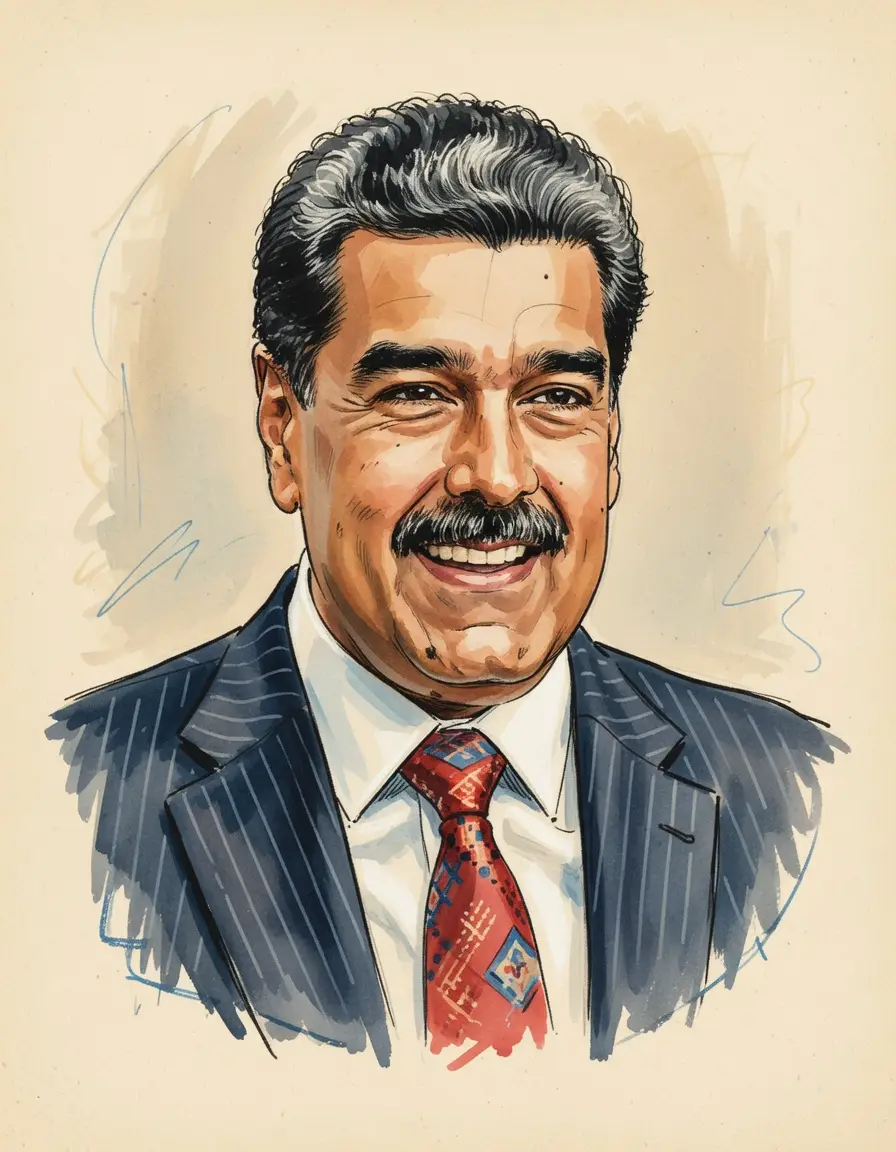
Nicolás Maduro on Political History
TL;DR
Nicolás Maduro views his rule as the continuation of Hugo Chávez's Bolivarian Revolution, aiming to preserve its socialist and anti-imperialist historical legacy.
Key Points
He faithfully supported Chávez's hardline anti-Americanism and populist policies, enabling his long tenure in office.
The regime of Maduro faced a stark choice to restrict electoral opportunities or risk losing power following the opposition's electoral gains by 2015.
The autocratic intensification phase under Maduro drew from pre-existing institutional resources like co-opted electoral authorities to respond to new threats.
Summary
Nicolás Maduro positions himself as the inheritor and faithful executor of the political and ideological project initiated by Hugo Chávez, often referred to as the Bolivarian Revolution. This historical framing legitimizes his government by linking it directly to the popular mandate that brought Chávez to power starting in 1999, which involved both democratic electoral victories and periods of intense political confrontation. Maduro's tenure is characterized by continuing the hardline anti-Americanism and populist distributive policies established by his predecessor, using the historical narrative to defend his regime against domestic and international opposition. He frames his actions as necessary responses to historical enemies and forces attempting to derail the socialist project.
The evolution of his position is tied to the progression of 'Chavismo' from its semi-authoritarian phase under Chávez to a more intensely autocratic one under his rule following the latter's death in 2013. While Chávez’s era was marked by an uneven assault on democratic institutions amidst high oil wealth, Maduro's continuation involved a simultaneous, aggressive attack on all aspects of democracy, driven by economic crisis and declining electoral competitiveness. Maduro’s approach, therefore, involves reinforcing and repurposing the autocratic institutional tools developed under Chávez to ensure regime survival and maintain the historical line against what he portrays as external and internal oligarchic opposition. His political history is explicitly presented as the ongoing defense of the Bolivarian historical path.
Frequently Asked Questions
Nicolás Maduro views his presidency as a direct, necessary continuation of the historical project started by Hugo Chávez, known as the Bolivarian Revolution. He often frames current events through the lens of a historical struggle against 'imperialism' and the Venezuelan 'elite' that opposed Chávez. His political history narrative serves to legitimize his government's adherence to socialist principles and anti-U.S. stances.
Maduro presents himself as the chosen successor who is carrying forward the political program and legacy of Chávez, emphasizing his role in defending the revolution after Chávez's death in 2013. He claims to face the same enemies who historically sought to undo Chávez's work, thus justifying his consolidation of power and autocratic measures as safeguarding a historical accomplishment.
The political history of the regime under Maduro has seen an intensification of autocratic methods, differing in execution from the earlier phase under Chávez. While Chávez’s period involved a mix of democratic expansion and regression, the transition to full authoritarianism under Maduro involved a simultaneous attack on minimal, liberal, and participatory democracy when electoral competitiveness declined.
Sources6
Venezuela between repression and resistance
Venezuela: Why Chavismo Came to Power, How the Country Collapsed, Maduro's Fall, and an Uncertain Future
Chavez, Maduro, and the making of Venezuela
Venezuela's Autocratization, 1999–2021: Variations in Temporalities, Party Systems, and Institutional Controls
Venezuela at the crossroads: The presidential elections of July 28 and their consequences
Maduro's Arrest Signals End of Chavismo Era
* This is not an exhaustive list of sources.