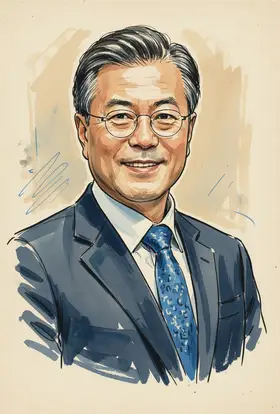
Moon Jae-in
- Known for
- 12th President of South Korea, Lawyer and human rights activist, Sunshine Policy approach
- Born in
- Geoje, South Korea
- Education
- Kyung Hee University
Moon Jae-in is a South Korean politician and lawyer who served as the 12th president (2017–2022), emerging from a background of poverty and human rights activism alongside Roh Moo-hyun. Defined by his commitment to peaceful inter-Korean relations and progressive domestic reform, his presidency marked a significant shift in South Korean politics.
Signature Positions
Moon's administration focused heavily on diplomacy, economic restructuring, and social welfare expansion:
- North Korea: Advocated for peaceful reunification and engagement, holding historic inter-Korean summits with Kim Jong Un and aligning with the Sunshine Policy.
- Economic Policy: Championed Income-led growth, raising the minimum wage significantly (16.4% in 2018) and reducing the maximum work week from 68 to 52 hours.
- Chaebol Reform: Appointed a shareholder activist to curb the concentrated power of chaebols (conglomerates) through improved governance.
- Energy: Implemented a plan to move away from nuclear power and coal, favoring natural gas and renewables as interim solutions.
- COVID-19: Received international praise for a proactive and transparent response to the COVID-19 pandemic, although domestic approval ratings fluctuated.
Notable Tensions
Moon's tenure was marked by several significant domestic and social policy contradictions:
- LGBT Rights: Despite being a former human rights lawyer, Moon expressed opposition to homosexuality and same-sex marriage during his 2017 campaign, later softening his stance to oppose discrimination but not legalization.
- Unemployment Concerns: Critics argued that rapid pro-labor policies, such as minimum wage hikes, contributed to rising unemployment rates, particularly among the youth, in the early years of his term.
- Prosecution Reform: His administration aggressively pursued prosecution reform to weaken the monolithic power of the prosecution, leading to resignations and intense institutional backlash, including the establishment of the Corruption Investigation Office for high-ranking officials.
- Housing Crisis: Despite strong legislative power, the administration failed to effectively resolve the deepening housing crisis in the Seoul metropolitan area, a key factor cited in his party's 2022 election loss.
Moon's presidency is remembered for raising South Korea's profile as a middle power through his New Southern Policy (NSP) aimed at diversifying trade relations beyond the US-China dynamic. He finished his term with historically high overall approval ratings but could not prevent his party from losing power after a single term, the first such occurrence since democratization in 1987. His post-presidency involved public criticism of his successor, Yoon Suk Yeol, whom he appointed as Prosecutor General.