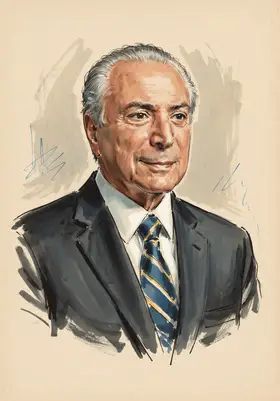
Michel Temer on Democracy
TL;DR
Michel Temer views democracy as the essential framework for governance, emphasizing constitutionalism and individual freedoms alongside social rights.
Key Points
He taught constitutional law for over 35 years and was a member of the 1988 National Constituent Assembly that drafted Brazil's current constitution.
In a 2018 joint statement, he affirmed that Brazil and the US share values like attachment to democracy and individual freedoms.
His administration authorized the military to take charge of security for Rio de Janeiro state in February 2018, signaling an increased military role in internal affairs.
Summary
Michel Temer, a career law professor and member of the 1988 National Constituent Assembly, consistently framed his political stance within the context of constitutional democracy. During his time as Vice President and President, he publicly affirmed Brazil's standing as the largest democracy in the Americas, linking its identity to the shared values of individual freedoms and liberties with allies like the United States. His academic background reinforced a focus on ensuring the Brazilian Constitution's provisions for social rights, such as food and dignity, were implemented alongside individual rights, advocating for a "democracy of food on the table."
His presidency, however, occurred during a period of significant institutional strain following the impeachment of his predecessor, which some characterized as leading to a "democratic vacuum" where unpopular neoliberal reforms were pursued with a fragile mandate. While his administration operated within the formal institutional context, the necessity of securing support, including from the military for internal security, led to actions, like expanding military involvement in domestic affairs, that some analysts argued compromised democratic health and civil-military balance. His legacy is thus tied to upholding formal democratic procedures during a period of deep political crisis and implementing significant economic changes under these conditions.
Frequently Asked Questions
Michel Temer views democracy as a system that must be upheld institutionally and constitutionally. As a former law professor, he emphasized the importance of codified rights, including both individual freedoms and crucial social rights, in a functional democracy.
Yes, Temer succeeded his predecessor following an impeachment process which some observers termed a 'legislative coup,' leading to an administration with a mandate questioned by critics. His tenure was characterized by efforts to stabilize the government while pursuing controversial economic reforms.
During a 2018 meeting, Michel Temer expressed agreement with the United States on the urgent need to reestablish full democratic normality in Venezuela. He also highlighted Brazil's commitment to receiving Venezuelan migrants with dignity.
Sources6
Remarks by the Vice President and President Michel Temer of Brazil in Joint Press Statements in Brasilia, Brazil
Brazil After Dilma: Temer's Turn
Brazil's Vice President Michel Temer Takes to the Classroom
Brazilian Democracy Under Military Tutelage
Reforming in a democratic vacuum: the authoritarian neoliberalism of the Temer administration from 2016 to 2018
Brazil's Simmering Democratic Demise
* This is not an exhaustive list of sources.