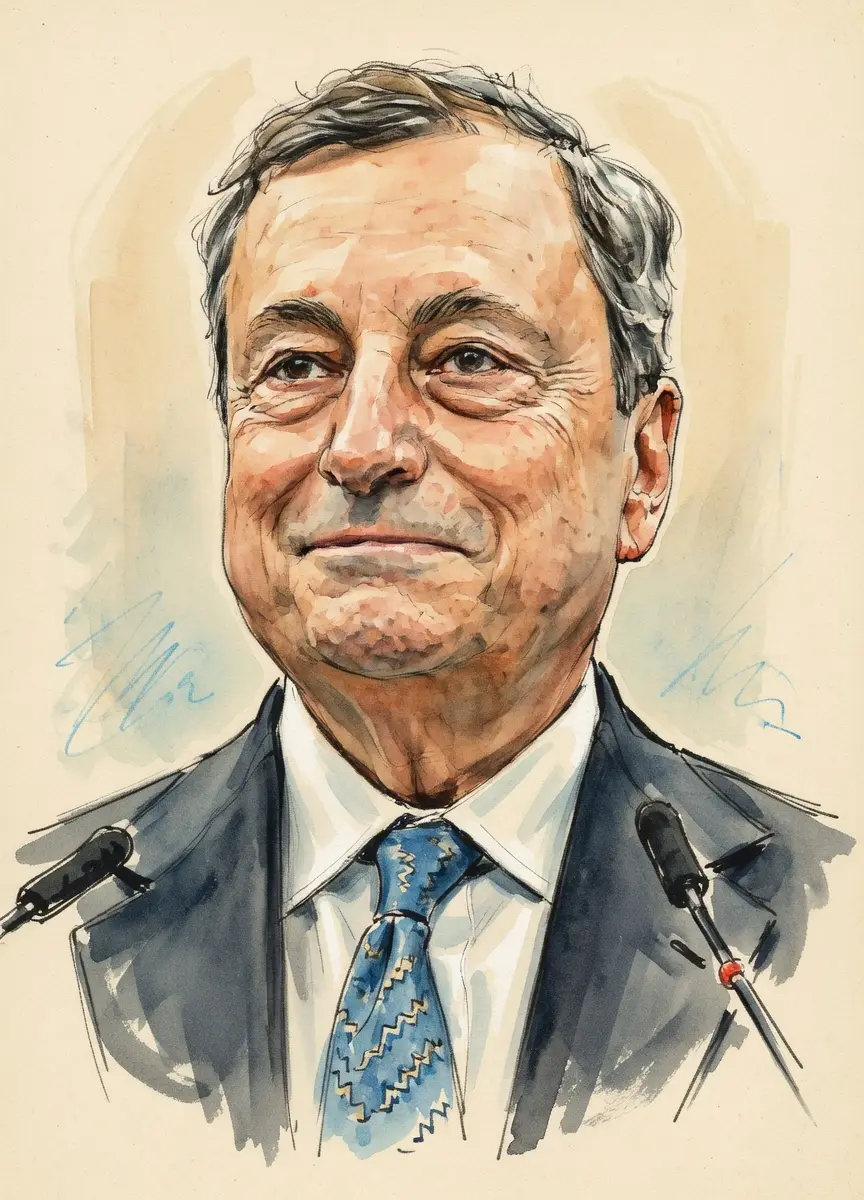
Mario Draghi on Fiscal Union
TL;DR
Mario Draghi strongly advocates for a European Fiscal Union to deliver necessary security and prosperity amidst modern challenges.
Key Points
He stated in 2014 that completing EMU required achieving minimum requirements in Banking Union, Capital Markets Union, and Economic and Fiscal Union for permanent stability.
Draghi believes that the failure to have explicit fiscal transfers mirrors the original design flaw of the euro, which lacked the necessary components of an optimal currency area.
He contends that the current geopolitical reality—marked by war, energy crisis, and strategic competition—makes a common fiscal action via a Fiscal Union model like NextGeneration EU essential, not a 'one-off'.
Summary
Mario Draghi asserts that the European Economic and Monetary Union remains dangerously incomplete without a central fiscal capacity, echoing the US model where a federal treasury complements the central bank. He argued that the absence of this fiscal capacity leads to an undersupply of stabilizing macroeconomic policy initiatives, creating a classic 'free rider' problem for essential collective actions like climate transition investment and defense spending. This lack of centralized funding capability constrains the EU's ability to address shared, supranational challenges effectively, risking economic stagnation and geopolitical irrelevance.
His position has evolved toward framing Fiscal Union not primarily as a mechanism to address past crises caused by unsound national policies, but as a necessity to finance large, shared, future-oriented investments in defense, the green transition, and digitisation. He suggests that true fiscal union requires a political process and a re-thinking of the EU’s fiscal framework, possibly by federalizing some investment spending and issuing common debt, ultimately demanding a revision of EU treaties for enhanced representation.
Key Quotes
As it stands, however, Europe neither has a federal strategy to finance them, nor can national policies take up the mantle, as European fiscal and state-aid rules limit the ability of countries to act independently.
So over the longer-term, it would be natural to reflect further on whether we have done enough in the euro area to preserve at all times the ability to use fiscal policy counter-cyclically. But it is also clear that… this could only take place in the context of a decisive step towards closer Fiscal Union
The starting point of any future Treaty change must be the acknowledgement of the increasing number of shared goals and the need to finance them together, which in turn necessitates a different form of representation and centralised decision-making.
Frequently Asked Questions
Mario Draghi is a strong advocate for the creation of a European Fiscal Union to complement the existing Monetary Union. He views it as essential for providing macroeconomic stabilization and financing vast supranational investments required by the current geopolitical and environmental challenges. He sees it as completing the monetary union to ensure its long-term stability and prosperity.
He argues that current challenges like defense, the green transition, and industrial base competition require massive, coordinated public investment that national budgets, constrained by existing fiscal rules, cannot adequately support. The era of relying on the US for security, China for exports, and Russia for energy is over, necessitating a new collective fiscal response. He advocates for an institutional structure that enables this, possibly via a permanent fiscal capacity.
Yes, Mario Draghi, having been involved in the early negotiations, was aware of the serious economic concerns, specifically the lack of fiscal transfers, when the euro was launched. He described moving forward as sidestepping contradictions, with the genuine belief that commitment to European unity would drive necessary changes later, though this 'functionalist' path has been slow.
Sources6
15th Annual Martin Feldstein Lecture Presented by Mario Draghi, former President, European Central Bank and former Prime Minister, Italy
Stabilisation policies in a monetary union
Europe's Fiscal Gap
Mario Draghi: Stability and prosperity in Monetary Union
Fiscal union in the euro zone: the only way to deliver the security and prosperity that European citizens crave
Europe's Fiscal Crossroads
* This is not an exhaustive list of sources.