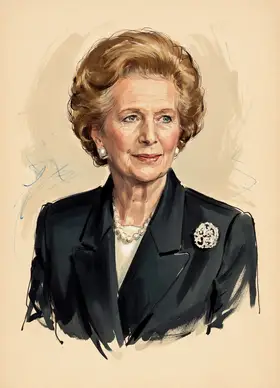
Margaret Thatcher on Trade Unions
TL;DR
Margaret Thatcher viewed powerful trade unions as an enemy within that had to be decisively curbed through legal reform and confrontation.
Key Points
Her government passed the Employment Act 1980, which banned secondary picketing and increased rights for non-union employees.
Cabinet papers show she aimed to "neglect no opportunity to erode trade union membership" well before the 1984 miners' strike.
The government systematically prepared for the year-long miners' strike (1984-1985), building coal stocks in anticipation of the confrontation.
Summary
Margaret Thatcher's core position was that the immense, unchecked power of trade unions, which had toppled previous governments, was an obstacle to economic growth and a danger to liberty. She sought to fundamentally reverse the balance of power by enacting a series of legislative reforms designed to reduce union influence, outlaw secondary picketing, and mandate secret ballots for industrial action. Key evidence of this determination is found in cabinet papers showing a long-held ambition to erode union membership and influence before securing a clear majority.
Her approach contrasted with her predecessors by being strategic and incremental, building up legal restrictions over time rather than attempting immediate, sweeping changes that had failed before. The defining moment of this stance was the government's preparedness for and ultimate victory over the National Union of Mineworkers during the 1984-1985 strike, which the archives reveal was anticipated and prepared for through stockpiling resources. This successful confrontation, alongside legal measures, marked a lasting transformation in the role unions played in the UK.
Key Quotes
We always have to be aware of the enemy within, which is much more difficult to fight and more dangerous to liberty
Frequently Asked Questions
Margaret Thatcher's primary goal was to curb what she perceived as the excessive and damaging power of trade unions in Britain. She believed this power stifled economic growth and undermined the authority of the democratically elected government. Her administration enacted legislation to restrict their activities, culminating in the decisive defeat of the miners' union.
She adopted a strategic, step-by-step legislative approach, contrasting with the failure of earlier, more sudden reforms. Crucially, she combined this with a willingness to face down major union leaders, most famously Arthur Scargill, a confrontation that her predecessors had avoided or lost.
Her government introduced legislation like the Employment Act 1980 and the Trade Union Act 1984. These measures restricted actions such as secondary picketing and required secret ballots before official industrial action could take place, aiming to empower individual union members over militant leadership.
Sources6
The Iron Lady: Thatcher and the Unions - The 1440 Review
Trade unions in the United Kingdom - Wikipedia
National archives: Margaret Thatcher wanted to crush power of trade unions | National Archives | The Guardian
Thatcher years | South West Trade Union History | Tolpuddle Martyrs
Speech to Conservative Trade Unionists | Margaret Thatcher Foundation
Thatcherism, trade unionism and all that — Adam Smith Institute
* This is not an exhaustive list of sources.