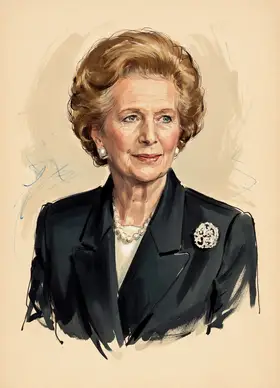
Margaret Thatcher on Strikes
TL;DR
Margaret Thatcher viewed militant trade unions as an 'enemy within' that threatened the nation's economic and democratic stability, leading her to confront them decisively.
Key Points
She famously labelled militant trade unionists as 'the enemy within' during the 1984 miners' strike, comparing the conflict to the Falklands War.
Her government implemented legislation including the Employment Act of 1980, which restricted picketing and promoted individual employee rights over union power.
The 1984-1985 miners' strike concluded on March 3, 1985, with the government achieving victory without making any concessions to the National Union of Mineworkers.
Summary
Margaret Thatcher's core position on strikes was one of uncompromising opposition, particularly when she perceived them as attempts to substitute the rule of the mob for the rule of law. Her government confronted the National Union of Mineworkers (NUM) in the defining 1984-1985 United Kingdom miners' strike, viewing the confrontation as necessary to curb the excessive power of trade unions and restore economic efficiency through privatization and closures of uneconomic pits. She believed capitulating to the miners' impossible demands would cripple the economy and fundamentally undermine parliamentary democracy, leading her to prepare strategically with coal stockpiles and police mobilization to ensure the country would not be brought to a standstill as previous governments had been.
Her tenure was marked by legislative changes, such as the Employment Act of 1980, which sought to reduce union dominance by banning secondary picketing and promoting individual rights over collective bargaining. The defeat of the year-long miners' strike, which ended without the government making a single concession, cemented her 'Iron Lady' reputation. This victory had lasting implications, causing a sharp fall in overall union membership and paving the way for the privatization of major British industries. The government's stance during this period demonstrated a clear evolution from past conciliation to a determined political and legal strategy against what she saw as illegitimate union power.
Frequently Asked Questions
Margaret Thatcher held a strong negative view of strikes, particularly those she considered politically motivated or resulting from 'impossible demands' by militant unions. She viewed such industrial action as a direct threat to the economic recovery and the democratic authority of the elected government. Her response was consistently one of confrontation rather than conciliation, as demonstrated during the miners' strike.
She learned from the failures of her predecessors by preparing a 'defence in depth' against the expected strike by the National Union of Mineworkers. This preparation included secretly stockpiling coal to safeguard against power cuts and recruiting non-union drivers to move supplies. She also ensured police forces were strategically organized to deal with mass picketing.
No, the Prime Minister stated that one could never compromise on the right of management to manage any industry. She maintained that the closure of uneconomic pits was non-negotiable, arguing that refusing to close them would turn Britain into a 'museum society' unable to maintain its standard of living.
Sources7
What Margaret Thatcher can teach us about unions
The Iron Lady: Thatcher and the Unions
Remarks on the end of the miners' strike
When Margaret Thatcher Crushed a British Miners' Strike | HISTORY
1984–1985 United Kingdom miners' strike - Wikipedia
During the miners' strike, Thatcher's secret state was the real enemy within
* This is not an exhaustive list of sources.