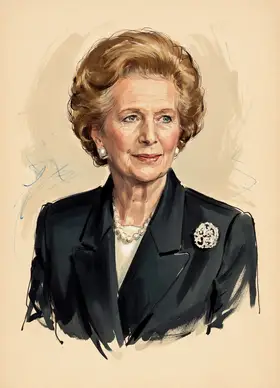
Margaret Thatcher on Nuclear Weapons
TL;DR
Margaret Thatcher strongly believed that Britain's independent nuclear deterrent was essential for national defense and preserving peace through deterrence.
Key Points
She stated in 1986 that the nuclear deterrent guarantees the defense of the United Kingdom and has worked successfully for over forty years.
She supported the decision to select the Trident missile system to ensure the deterrent remained effective well into the next century.
The government engaged in efforts to discredit peace organizations like the CND, arguing that unilateral disarmament would expose Britain to blackmail.
Summary
Margaret Thatcher held an unyielding position regarding the necessity of Britain's independent nuclear deterrent, viewing it as the ultimate guarantee of the United Kingdom's defense. She argued forcefully that because nuclear weapons exist and cannot be uninvented, unilateral disarmament would be a reckless gamble exposing the nation to blackmail by potential aggressors. This stance was central to her defense policy, asserting that the deterrent ensured security by making the price of an attack intolerable to any adversary. She maintained that possession of these weapons had successfully kept the peace in Europe for over forty years leading up to the mid-1980s.
The Prime Minister frequently stressed that the British deterrent was a vital element of the Atlantic Alliance's collective defense, but it also served as a defense of last resort should the United States' commitment to European defense be doubted or miscalculated by an aggressor. To remain effective against upgrading Soviet defenses, she championed the modernization of the system, exemplified by the choice of the Trident missile system. Her government actively defended the policy against peace activism, arguing that while arms control was desirable, it could only be contemplated after substantial reductions in the larger arsenals of the superpowers, as Britain's own capability was the minimum required for deterrence.
Frequently Asked Questions
Margaret Thatcher's core argument was rooted in deterrence; she believed that possessing an independent nuclear deterrent made the cost of aggression against the UK intolerable for any potential aggressor. She maintained that these weapons were the minimum necessary for the nation's security and had historically preserved the peace.
No, Margaret Thatcher was vehemently opposed to unilateral nuclear disarmament by Britain. She argued in an open letter that abandoning the deterrent would be a reckless gamble with the peace and security of future generations, exposing the country to blackmail.
She justified the modernization, such as choosing Trident, by stating that the deterrent had to remain adequate to overcome the defenses being developed against it by the Soviet Union. This capability upgrade was necessary to ensure the deterrent remained credible and effective for the long term.
Sources6
Open letter on nuclear disarmament ("The bomb has kept the peace for 40 years")
How did the UK Government respond to peace activism?
Echoes of the Thatcher's Nuclear Deterrence Narratives
Margaret Thatcher challenges the idea of abolishing nuclear weapons. She argues that the Soviet Union is in Europe, while the U.S. is far away across the ocean. Plus, we have to take political factors into account as well.
New Threats for Old
The Margaret Thatcher Foundation Archive : r/nuclearweapons
* This is not an exhaustive list of sources.