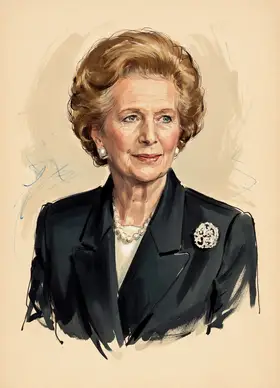
Margaret Thatcher on Mikhail Gorbachev
TL;DR
Margaret Thatcher initially viewed Mikhail Gorbachev as a pragmatic partner with whom she could 'do business' but maintained deep ideological differences.
Key Points
Thatcher famously stated after their 1984 meeting that she liked him and they "can do business together."
She condemned the 1991 Soviet coup attempt against him as a person who believed in liberty and democracy.
By June 1990, Thatcher had shifted her position to support German unification, assuring the Soviet leader that security concerns would be respected [cite: 1.6].
Summary
Margaret Thatcher's initial assessment of Mikhail Gorbachev, following their first meeting in 1984, was notably positive, famously stating she liked him and could "do business together" [cite: 1.3]. This early view was based on his apparent readiness for genuine, detailed discussion rather than adherence to prepared statements [cite: 1.4]. She saw common ground in a mutual desire to avoid war and build confidence, which she believed could foster success in disarmament talks [cite: 1.3]. However, their relationship evolved into one characterized by both agreement and profound disagreement, particularly concerning the role of nuclear weapons, where Thatcher remained adamant against abolition [cite: 1.2]. Despite finding common ground on topics like economic reform and regional conflicts, the fundamental ideological chasm remained, with Thatcher voicing concerns over the Soviet Union's foreign policy of communist world domination, which Gorbachev denied proclaiming [cite: 1.8]. Her position on Germany's reunification, initially resistant, softened over time, evolving to support it within a secure framework by 1990 [cite: 1.6].
Key Quotes
I believed that they would value it enough to make their views felt in the only way they could, and that judgment was correct.
Frequently Asked Questions
Margaret Thatcher formed a positive initial impression of Mikhail Gorbachev following their meeting in 1984, famously declaring that she liked him and they could "do business together." She noted his willingness to engage in genuine, detailed discussions rather than sticking to prepared statements. This established an important foundation for subsequent East-West diplomacy.
No, they did not agree on all major issues; their relationship was marked by both pragmatic cooperation and deep disagreement. They clashed profoundly over nuclear weapons, with Thatcher strongly opposing abolition while the Soviet leader advocated for it. While she praised his domestic reforms, she remained wary of the Soviet Union's foreign policy aims.
Thatcher's view evolved from immediate personal rapport to a more complex engagement defined by ideological friction alongside mutual respect. She was quick to condemn the 1991 coup plotters against him after leaving office, showing she valued his position. However, Soviet records show she vigorously challenged his positions on ideology and arms control throughout their tenure.
Sources7
From The Archives: RFE/RL Talks To Thatcher Following Failed '91 Soviet Coup
The Thatcher-Gorbachev Conversations:Agreement against German Unification, Encouragement on Economic Reform, Argument over Nuclear Abolition
TV Interview for BBC (“I like Mr Gorbachev. We can do business together")
Margaret Thatcher's Views on Mikhail Gorbachev | Making the History of 1989
Margaret Thatcher's Views on Mikhail Gorbachev
Prime Minister Thatcher addresses Mikhail Gorbachev | World History Commons
Record of Conversation between Mikhail Gorbachev and Margaret Thatcher, March 30, 1987
* This is not an exhaustive list of sources.