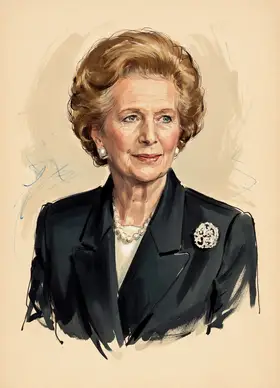
Margaret Thatcher on Economy
TL;DR
Margaret Thatcher championed free-market neoliberalism, prioritizing privatization, low taxes, and reducing trade union power to reverse national decline.
Key Points
She implemented policies based on monetarist thinking, including increasing interest rates to control the money supply and thereby reduce inflation, starting in 1979.
A key economic action was the privatization of state-owned companies, like British Airways and British Gas, driven by both ideological belief and the need for revenue.
The government famously rejected calls for a policy U-turn amid recession, with the leader stating in 1980, "You turn if you want to. The lady's not for turning."
Summary
Margaret Thatcher's core economic position, known as Thatcherism, was rooted in free-market neoliberal principles, intending to reverse Britain's perceived post-war economic stagnation, high inflation, and union dominance. Her policy set, implemented after her 1979 election victory, emphasized privatization of state-owned companies, reduction of government interference, and lowering direct income taxes, believing this would stimulate output and investment. She also drastically reduced the power of trade unions, notably through her successful confrontation with the miners' strike, aiming to shift the balance of power in industrial relations. Evidence suggests that while inflation was reduced and some private ownership expanded, her tenure also saw a marked slowdown in real GDP per capita growth and a significant increase in household debt.
The implications of her economic overhaul were deeply polarizing, with critics arguing that the pursuit of efficiency and individualism came at the cost of increased inequality, as incomes for the top earners grew much faster than for the lowest deciles. While she claimed to promote a 'capital owning democracy,' the era was marked by the hollowing out of the manufacturing sector and an increased dependency on financial services. Furthermore, while tax rates for the highest earners were slashed, increases in indirect taxes and bracket creep meant the overall real tax burden rose in the early years. The legacy remains contentious, with some attributing long-term relative economic improvement to her reforms while others point to decades of resulting regional blight and social division.
Frequently Asked Questions
Margaret Thatcher's main goal was to reverse what she saw as Britain's long-term economic difficulties, characterized by slow growth and high inflation. She aimed to achieve this by moving away from the post-war consensus towards a system based on free markets and individualism. This philosophical shift was intended to encourage greater personal responsibility and enterprise across the nation.
She was committed to reducing the power of trade unions, believing their leadership was undermining democracy and economic performance through strike action. Her government introduced legislation to curb union power, culminating in the defeat of the National Union of Mineworkers in the 1984–85 miners' strike. This action is credited by some with breaking the power of organized labour for a generation.
According to some analyses, the rate of economic growth, measured by real GDP per capita, actually slowed down after Thatcher took office in 1979 compared to preceding governments. While supporters credit her with halting Britain's relative decline, critics suggest that any improvement rested on non-repeatable windfalls like North Sea oil revenue.
Sources8
Margaret Thatcher - Wikipedia
1979 and all that: a 40-year reassessment of Margaret Thatcher's legacy on her own terms
No, Margaret Thatcher Didn't Save the British Economy - Jacobin
How different would the British economy be today if Margaret Thatcher was never Prime Minister? : r/EconomicHistory
Thatcher Did Not Stimulate Economic Growth | Cato Institute
Thatcherism | Definition, Policies, Neoliberalism, & Reaganism | Britannica
Did Margaret Thatcher transform Britain's economy for better or worse? | Larry Elliott, economics editor | The Guardian
Margaret Thatcher's economic experiment: are there lessons for the Reagan administration?
* This is not an exhaustive list of sources.