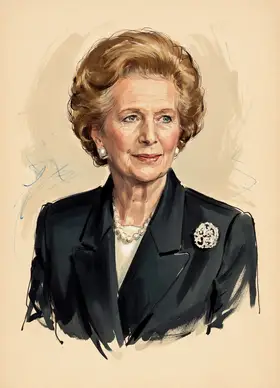
Margaret Thatcher on Communism
TL;DR
Margaret Thatcher viewed Communism as the most destructive political ideology, fundamentally opposed to freedom, justice, and individual prosperity.
Key Points
She stated that nations that pursued equality through Communism achieved neither freedom nor justice, resulting in the greatest inequalities.
In 1976, she embraced the Soviet insult "Iron Lady" as a symbol of her defense of values fundamental to the Western way of life.
She believed Communism produces neither dignity nor prosperity, as it takes power from the people and places it in a self-appointed elite.
Summary
Margaret Thatcher held an uncompromisingly negative view of Communism throughout her career, seeing it as the antithesis of Western liberal democracy and values. She characterized it as the most cruel and total elimination of freedom the world had ever known, directly responsible for immense human suffering and death, contrasting it sharply with the freedom and justice offered by a capitalist, rule-of-law society. She believed that Communism strips power from the people, placing it in a self-appointed elite, and stifles individual talent, thereby preventing progress and prosperity.
Her stance was deeply rooted in her conservative belief in individual liberty and personal responsibility, which she felt Marxism sought to replace with state control. This belief system informed her foreign policy, leading her to back the assertive stance against the Soviet Union during the latter stages of the Cold War alongside the US President. While she famously stated, "I like Mr Gorbachev. We can do business together," this referred to a pragmatic engagement aimed at promoting change, not an endorsement of the Communist system itself. She actively worked to expose the weaknesses of the Soviet model and championed the Western way of life as infinitely superior for every human being.
Frequently Asked Questions
Margaret Thatcher was a vocal and strong opponent of Communism, considering it the most destructive political ideology created by man. According to her statements, she believed Communism fundamentally denied choice to ordinary people and led to tyranny, poverty, and the deaths of millions, as detailed in speeches from the 1970s onward.
Yes, Margaret Thatcher believed in engaging pragmatically with Soviet leaders like Mikhail Gorbachev, famously stating, "We can do business together" after meeting him. However, this was a means to an end, as she maintained that Britain must be strong to defend its ideals against the existential threat posed by the ideology itself.
Thatcher asserted that Communism ultimately fails to generate prosperity because it prevents progress by manipulating and distorting individual talents rather than allowing them to flourish, according to her writings and speeches. She contrasted this with capitalism, which she felt correctly rewarded individuals who served the needs of others through the market.
Sources6
Margaret Thatcher Quotes About Communism
The Iron Lady Confronts Socialism
Margaret Thatcher and the Collapse of Communism
'Fight Boldly' for Democracy, Thatcher Urges
Speech to the Fraser Institute ("The New World Order") | Margaret Thatcher Foundation
Margaret Thatcher and the Cold War
* This is not an exhaustive list of sources.