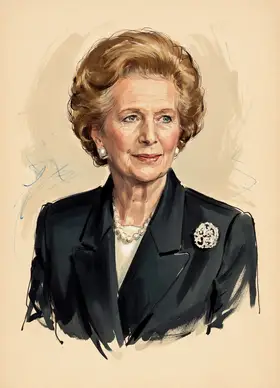
Margaret Thatcher
- Known for
- Thatcherism policies, Iron Lady, Falklands War leadership
- Born in
- Grantham, UK
- Education
- Master of Arts, Somerville College, Oxford
Margaret Thatcher, the UK's first female Prime Minister, defined an era with her uncompromising politics, earning the moniker “Iron Lady” from the Soviets. Her tenure (1979–1990) fundamentally shifted British politics towards neoliberal policies, challenging the post-war consensus.
Signature Positions
Thatcherism centered on individual liberty, reduced state power, and confronting institutional opposition:
- Trade Unions: Fiercely committed to reducing union power, culminating in the defeat of the miners' strike (1984–85).
- Privatisation: Accelerated the sale of state utilities, arguing it improved performance and reduced the reach of socialism.
- Economy and Taxation: Implemented monetarist policies, lowering income tax while prioritizing inflation control over unemployment levels.
- Falklands War: Led a decisive military response to the Argentine invasion in 1982, a defining moment of her premiership.
- Europe: Strongly supported EEC membership but fiercely opposed deepening political integration, famously warning against a “European super-state”.
How Views Have Evolved
While known for staunch views, some positions evolved:
- Hong Kong: Initially sought a continued British presence, but ultimately conceded sovereignty to China via the Sino-British Joint Declaration (1984).
- Europe: While initially pro-EEC, her stance hardened significantly against integration after 1987, culminating in her opposition to the ERM and her Bruges speech.
Notable Tensions
Thatcher’s tenure generated significant domestic tension and controversy:
- Immigration: Acknowledged public hostility towards large-scale immigration to win votes from the National Front, leading to accusations of pandering to racism.
- Northern Ireland: Maintained a hard line against prisoner status during the 1981 hunger strikes (declaring 'Crime is crime is crime'), yet signed the Anglo-Irish Agreement (1985), granting an advisory role to the Republic of Ireland.
- Environment: Despite her later skepticism about climate change, she supported an active climate protection policy in the late 1980s, including establishing the Hadley Centre.
Thatcher’s relationship with Ronald Reagan cemented a strong transatlantic alliance against the Cold War Soviet threat. Though polarizing in life, retrospective polling often ranks her among the greatest post-war leaders, credited with fundamentally changing the direction of both the Conservative and Labour parties.