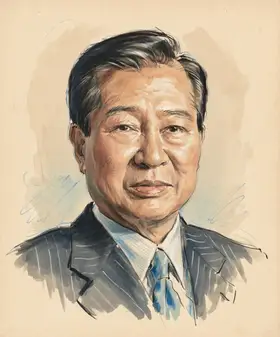
Kim Dae Jung on Administration
TL;DR
Kim Dae Jung's administration focused on structural economic reforms, participatory democracy, and engagement with North Korea.
Key Points
His administration enacted rigorous economic restructuring reforms following the 1997 Asian financial crisis, leading to economic recovery by 1999.
He established the Sunshine Policy toward North Korea, culminating in the historic inter-Korean summit with Kim Jong Il in June 2000.
Kim Dae Jung committed to political reforms, including pledging an end to regional discrimination and realizing participatory democracy, starting from his inauguration in 1998.
Summary
Kim Dae Jung's presidency, beginning in 1998, was characterized by comprehensive administrative reforms aimed at overcoming the national economic crisis and ushering in a new era of development. His core approach merged neoliberal economic restructuring, heavily influenced by IMF recommendations, with a push for participatory democracy, contrasting with previous authoritarian styles of governance. Key to his domestic policy was transforming the economy by enforcing greater corporate transparency among the chaebols, reducing their cross-guarantees, and fostering a knowledge-based economy through ICT infrastructure development. This concurrent focus on both democracy and the market economy was central to his governing philosophy for achieving national revival.
His approach to administration also included significant political and social reforms designed to create a more equitable state. He pledged to end regional discrimination in personnel and development, aiming for a "government of the people" where all parts of the country could partake in national administration. Furthermore, his administration saw a tripling of social protection expenditure, expanding unemployment insurance and introducing public work programs to address the fallout from economic restructuring. A major international aspect of his administration was the pursuit of the Sunshine Policy toward North Korea, a policy of détente that resulted in the first inter-Korean summit in 2000 and earned him the Nobel Peace Prize.
Key Quotes
As we mark the 50th anniversary of the Republic of Korea, we are taking the first step on a long journey toward the second nation- building.
I have lived, and continue to live, in the belief that God is always with me.
Frequently Asked Questions
Kim Dae Jung's administration centered on two major interconnected goals: implementing comprehensive economic reforms to recover from the Asian Financial Crisis and advancing democracy. He pushed for neoliberal policies and structural changes within corporations and finance. He also prioritized improving inter-Korean relations through his Sunshine Policy.
The government vigorously pushed economic reforms and restructuring recommended by the International Monetary Fund, notably enforcing corporate governance transparency for the chaebols. He also focused on building up the country's high-speed Information and Communications Technology infrastructure to transition to a knowledge-based economy.
Yes, despite his history as a democratic reformer, Kim Dae Jung's administration faced political challenges, including accusations of using strong-arm tactics against opponents and journalists. His coalition government also struggled initially to gain a legislative majority, leading to stalled reform efforts.
Sources9
Kim Dae Jung: A Future Leader's Moment of Truth
Kim Dae-jung's Role in the Democratization of South Korea
A Case Study of The Kim Dae-Jung Administration
Kim Dae-jung
Inaugural Address by Kim Dae-jung the 15th-term ...
Kim Dae-jung – Biographical
ROK President Kim Dae-jung Speech
Five Years of the Kim Dae-jung Administration
24/ The Kim Dae-Jung Administration's - Reunification Policy
* This is not an exhaustive list of sources.