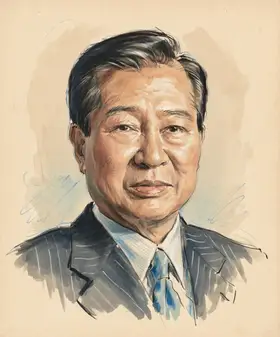
Kim Dae Jung on Lee Kuan Yew
TL;DR
Kim Dae Jung offered a cosmopolitan challenge to Lee Kuan Yew's defense of restrictive 'Asian values' by championing universal democracy.
Key Points
Kim Dae Jung directly critiqued Lee Kuan Yew's position as representing an authoritarian posture and an "Orwellian extreme of social engineering" in 1994.
He argued that democratic ideals like government accountability, present in Meng-tzu's philosophy, existed in Asia long before John Locke formalized them in the West.
Kim's interpretation of Asian values was distinguished from Lee's by incorporating a cosmopolitan vision that allowed for dialogue with the West while retaining Asian identity.
Summary
Kim Dae Jung engaged in a significant ideological contest with Lee Kuan Yew, primarily through a debate sparked by Lee’s 1994 Foreign Affairs interview which defended a soft authoritarianism based on unique Asian cultural values. Kim’s core position, as an opposition leader who later became president, countered Lee’s defense of collective well-being over individualism by arguing that Asian cultures, particularly Confucianism, contain inherent philosophical roots supporting freedom and democracy, such as the concept of popular sovereignty. His stance was later described as a cosmopolitan orientation, which sought an interculturally constructive dialogue with the West while reinterpreting Asian identity, thereby distinguishing his view from Lee’s perceived binary opposition between East and West. This fundamental disagreement over the applicability of democracy and human rights in Asia defined a key intellectual conflict for both leaders.
Frequently Asked Questions
The main disagreement centered on the relationship between East Asian culture and democracy. Lee Kuan Yew argued that cultural differences made Western-style democracy unsuitable for Asia, justifying his restrictive governance. Kim Dae Jung countered that Asia possessed its own deep-rooted traditions supporting democracy and human rights.
No, Kim Dae Jung did not entirely reject Asian values; instead, he reinterpreted them. He sought to demonstrate that Eastern notions of human rights and democratic principles had internal roots within Asian cultural traditions, thus challenging the notion that they were solely Western imports.
Kim Dae Jung characterized Lee Kuan Yew's government interventions in citizens' daily lives as nearly totalitarian, citing it as an 'Orwellian extreme of social engineering.' He viewed Lee's authoritarianism as a contradiction to the spirit of good governance he saw within Confucianism's better aspects.
Sources5
Revisiting the 'Asian values' debate - The Korea Times
From the Asian Value Debate to Cosmopolitanism: An Active Interpretation of the Political Thoughts of Kim Dae-jung*
Lee Kuan Yew versus Kim Dae-jung: the Battle for Asia's Soul - Ask a Korean!
A Response to Lee Kuan Yew Is Culture Destiny?
17.541J - Week 4
* This is not an exhaustive list of sources.