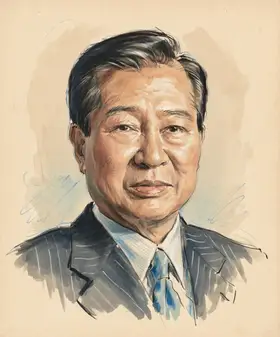
Kim Dae Jung on Historical Legacy
TL;DR
Kim Dae Jung's historical legacy is largely defined by his progressive approach to inter-Korean reconciliation, known as the Sunshine Policy.
Key Points
He was a co-chair of the first Forum of Democratic Leaders in the Asia-Pacific Region meeting in Seoul in 1995.
His administration initiated the Sunshine Policy, prioritizing reconciliation and economic incentives for North Korea.
The 1998 joint declaration with the Japanese Prime Minister was a major achievement in managing historical legacy issues.
Summary
Kim Dae Jung's core historical legacy centers on his administration's pursuit of the Sunshine Policy, which prioritized reconciliation, cooperation, and gradual normalization with North Korea over outright confrontation. This policy marked a significant departure from previous hardline stances, culminating in the landmark June 2000 inter-Korean summit and the subsequent Joint Declaration. He viewed this engagement as a strategic identity project, aiming to reposition North Korea from an existential threat to a potential partner and to establish South Korea as a regional norm entrepreneur rather than a mere junior alliance actor. This approach was deeply rooted in the progressive vision forged during the democratization movement, linking peaceful coexistence to broader national solidarity goals.
The implications and subsequent perception of this legacy have been shaped by later geopolitical shifts and the evolution of his political movement. His strategy established the foundational principles for South Korean progressives in the post-democratization era, emphasizing economic engagement as the surest path to national reconciliation and autonomous policymaking. While later progressive administrations adapted these principles to new realities like North Korea's nuclear maturity, the framework initiated by the Kim Dae Jung government remains a critical touchstone for assessing progressive foreign policy identity and its historical significance in inter-Korean relations.
Frequently Asked Questions
Kim Dae Jung's historical legacy is most strongly associated with his progressive foreign policy, particularly the Sunshine Policy towards North Korea. He viewed engagement and reconciliation as key to overcoming the peninsula's division. His efforts also touched upon historical perceptions with Japan, resulting in a joint declaration.
The Sunshine Policy is viewed as a pivotal shift in South Korean progressive foreign policy, moving away from confrontation toward engagement. It defined a strategic identity project for his administration, centered on peaceful coexistence. However, its effectiveness is often debated in light of subsequent North Korean provocations.
Yes, the former president was involved in efforts to manage historical legacies with Japan, notably through the 1998 joint declaration with the Japanese Prime Minister. This declaration represented an achievement in addressing past actions, though its impact on public sentiment in both nations has been noted as limited.
Sources7
Engaging North Korea: The Clouded Legacy of South ...
The Transformation of South Korean Progressive Foreign ...
Documents on Democracy
U.S. Policy toward Northeast Asia: A View from South Korea
EAI 동아시아연구원
U.S. Expert on Korean Affairs Calls for Reframing of Tokyo ...
Brothers in the mirror: Taiwan & Korea's road to democracy ...
* This is not an exhaustive list of sources.