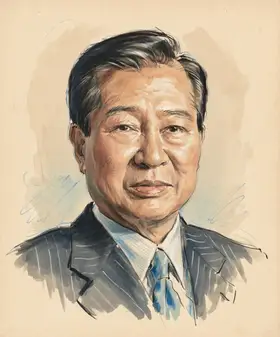
Kim Dae Jung on Death Penalty
TL;DR
Kim Dae Jung consistently called for the abolishment of the death penalty, believing it failed to curb crime and contradicted democracy.
Key Points
He made a public call for the abolishment of capital punishment in October 2007, stating it had failed to curb rising crime rates.
The Kim Dae-jung government did not carry out any executions during its entire five-year term in office.
He was sentenced to death in 1980 during the struggle for democracy and survived the sentence due to international campaigning.
Summary
Kim Dae Jung was a vocal and consistent opponent of the death penalty, viewing it as an action that went against democracy and fundamental human rights. As a former death row inmate himself, he argued that capital punishment was vainly taking lives without improving societal peace or stability. He sincerely hoped for its abolishment to achieve full democracy globally, asserting that no human should kill another, and that life is a God-given right which no one can violate.
During his presidency, he actively campaigned against the practice by refusing to sign death sentences, a prerequisite for executions to take place. Although his government carried out no executions during his five-year term, his efforts to formally lift sentences for those on death row only succeeded for thirteen individuals. Even after leaving office, he continued his commitment by contributing articles to human rights watchdogs and speaking in support of abolition campaigns in 2006 and 2007.
Key Quotes
``Executions took away people's lives only in vain, without making any improvement to the stability and peace of society,''
Frequently Asked Questions
Kim Dae Jung held a strong position opposing the death penalty throughout his life. He argued that it was an action contrary to democracy and human rights principles. He continuously called for its abolishment in South Korea and across Asia.
Yes, Kim Dae Jung was sentenced to death in September 1980 on charges related to political activities against the military regime. His sentence was eventually commuted following widespread international protest and campaigning.
As President, Kim Dae Jung ensured that no executions were carried out during his tenure from 1998 to 2003. This practice of not executing individuals on death row contributed to South Korea's status as a de facto abolitionist country.
Sources6
Kim Dae-jung Calls for Ending Death Penalty
Kim Dae-jung, human rights champion and former South Korean president, dies
Kim Dae-jung: Life on Death Row
South Korea's Ambivalent Position on the Death Penalty — Cornell Center on the Death Penalty Worldwide
Why hasn't South Korea abolished the death penalty? - Planète Corée
[Herald Interview] 'South Korea should lead abolition of death penalty in Asia-Pacific'
* This is not an exhaustive list of sources.