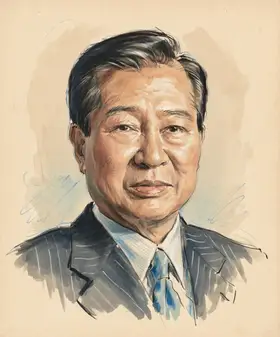
Kim Dae Jung
- Known for
- Sunshine Policy, Democratization movement
- Born in
- Hauido, Korea, Empire of Japan
- Education
- Master's course in economics, Harvard University
Kim Dae Jung was a South Korean statesman and democratic activist, often called the "Nelson Mandela of Asia," who tirelessly opposed military dictatorships. Serving as the 8th President (1998–2003), he broke decades of conservative rule to usher in an era of significant reform and reconciliation.
Signature Positions
Kim Dae Jung's presidency was defined by his commitment to reconciliation, economic restructuring, and democratic consolidation:
- Sunshine Policy: Championed a historic policy of détente with North Korea, culminating in the 2000 Inter-Korean Summit with Kim Jong Il.
- Economic Reforms: Implemented stringent neoliberal restructuring in response to the Asian Financial Crisis, prioritizing transparency and foreign investment to achieve rapid recovery.
- Democracy and Human Rights: Fought military regimes for decades, surviving assassination attempts and imprisonment to restore democracy.
- Nobel Peace Prize: Awarded the prize in 2000 for his work in advancing democracy, human rights, and reconciliation across East Asia.
Notable Tensions
Kim’s political career was marked by intense conflict and necessary compromises:
- Military Regimes: He was repeatedly targeted by dictators like Park Chung Hee and Chun Doo-hwan, facing imprisonment and a death sentence for challenging authoritarian rule.
- Political Compromise: His 1997 victory required an alliance with Kim Jong Pil, a former official under Park Chung Hee, creating friction within his own reformist base.
- Cash-for-Summit Scandal: His diplomatic engagement with North Korea was tainted by allegations that the government funneled hundreds of millions of dollars to Pyongyang to secure the 2000 summit.
Kim was the first opposition candidate to win the presidency, marking a crucial peaceful transfer of power in South Korean history. His legacy includes establishing the country’s contemporary welfare state and fostering a high-tech, knowledge-based economy. He remains one of South Korea's most highly rated presidents for his positive historical impact.