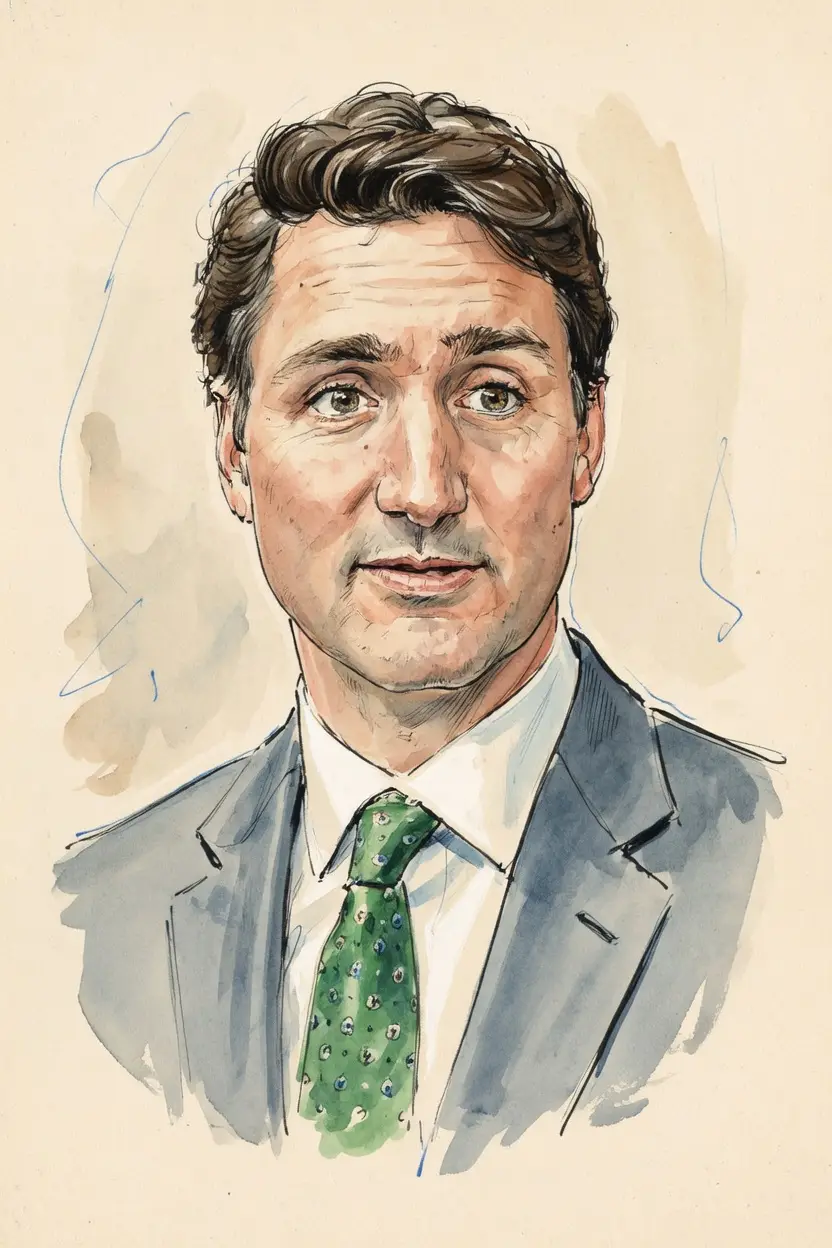
Justin Trudeau on Climate Change
TL;DR
Justin Trudeau centered his political career on implementing aggressive climate policies, including a national carbon price, while balancing the interests of the oil and gas sector.
Key Points
He announced enhanced climate action at COP26, including working toward ending thermal coal exports by 2030.
His government enacted the Net Zero Emissions Accountability Act to legally mandate five-year emissions reduction targets, aiming for net-zero by 2050.
The federal government implemented a pan-Canadian carbon pricing backstop, which began in 2019 and has an escalating price schedule.
In 2016, he committed nearly $3 billion over five years to address climate change and air pollution following the Paris Agreement.
His government purchased the Trans Mountain Pipeline expansion project, which ultimately cost $34 billion to complete.
Summary
Justin Trudeau's core position on climate change is one of strong advocacy for ambitious, government-led action to meet international commitments, such as the Paris Agreement goals and achieving net-zero emissions by 2050. Evidence of this stance includes the implementation of a federal carbon pricing system, strengthening Canada's 2030 emissions target, and passing domestic legislation to ensure accountability. Despite this, his record is marked by inherent contradictions due to his government's simultaneous support for the continued growth of the oil and gas industry, notably through the purchase and completion of the Trans Mountain Pipeline expansion.
This dual approach created a legacy that advocates describe as both revolutionary in policy innovation and insufficient in scope to address the crisis, leading to political backlash over energy costs. The government introduced regulations to cap and reduce oil and gas sector pollution, while also providing significant subsidies like tax breaks for carbon capture technology. Furthermore, his tenure saw the introduction of laws recognizing the right to a healthy environment and a national strategy on environmental racism, though the ultimate effectiveness of these measures remains subject to ongoing implementation and political uncertainty.
Key Quotes
“Canada is back, my friends,”
“Over the next five year we will invest nearly 3 billion dollars to address climate change and air pollution.
Frequently Asked Questions
Justin Trudeau has strongly positioned himself as a climate leader, emphasizing the need for concerted global and domestic action. His position centers on implementing policies like carbon pricing and setting ambitious emissions targets to achieve a net-zero economy by 2050. However, this stance is complicated by his government's support for the fossil fuel industry, which critics view as undermining genuine climate leadership.
The cornerstone of his climate policy is the implementation of the Greenhouse Gas Pollution Pricing Act, establishing a federal carbon price for provinces without an equivalent system. He views this as the most efficient mechanism for tackling carbon pollution. This policy has been defended constitutionally despite facing significant political and provincial opposition.
While the fundamental commitment to climate action remains, the approach has evolved to become more legally ambitious, such as enshrining net-zero goals into law and setting a 2035 target. Critics note that the severity of his climate actions has been inconsistent, particularly regarding major fossil fuel projects, suggesting an evolving attempt to balance climate goals with economic pressures.
Sources9
Justin Trudeau taxed fossil fuels — and paid the price
Prime Minister Trudeau announces enhanced and ambitious climate action to cut pollution at the COP26 summit
What is Justin Trudeau's environmental legacy? | The Narwhal
Justin Trudeau accomplished more on climate action than any other Prime Minister – and less than what's needed for a safe future - Climate Action Network Canada (CAN-Rac)
Trudeau leaves behind nearly a decade of climate action, but some key priorities hang in the balance | CBC News
'A Crushing Disappointment': Trudeau's Climate Legacy
MEDIA RELEASE: The Climate Legacy of Justin Trudeau: A Perspective from Citizens' Climate Lobby Canada
Canadian Prime Minister Justin Trudeau on Climate Change, Cybercrime, and Gender Equality – IMF F&D
UN / TRUDEAU | UNifeed
* This is not an exhaustive list of sources.