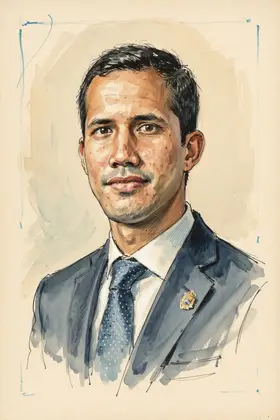
Juan Guaidó on Self-Declaration of Presidency
TL;DR
Juan Guaidó executed a self-declaration of the presidency based on his role as the head of the National Assembly.
Key Points
He declared himself interim president in early 2019, citing his constitutional role as head of the National Assembly.
His self-declaration was recognized by 88 countries and several international bodies, creating a dual-presidency crisis.
The declaration followed an attempt to push humanitarian aid across the Colombian border, which led to a border closure in 2019.
Summary
Juan Guaidó's position on the self-declaration of the presidency was central to his challenge to the sitting government, which began in early 2019. He asserted his legitimacy as the head of the National Assembly to assume the interim presidency, a move supported by numerous international entities. This action was taken in response to what he and his allies considered to be the illegitimacy of the incumbent president following disputed elections.
The context for this declaration included the international political standoff where many nations, including the European Parliament and the Organization of American States, recognized his claim. This event represented a high point in the opposition's attempt to regain constitutional control, though it ultimately did not result in the removal of the ruling administration.
Frequently Asked Questions
Juan Guaidó based his self-declaration of the presidency on his position as the legitimate head of the National Assembly. According to analysis of the Venezuelan political crisis, this move was a direct constitutional challenge to the incumbent leader. He assumed this interim role because his supporters argued the incumbent president's term was illegitimate.
According to reports from the period, Juan Guaidó's claim to the presidency was recognized by 88 countries. This international recognition included support from the European Parliament and the Organization of American States. This support was crucial in legitimizing his self-declaration on the world stage.
No, Juan Guaidó's self-declaration did not ultimately lead to a change in the government, despite significant international backing. The political challenge he mounted, which included an attempt to open the border, did not displace the incumbent administration. The situation evolved into a protracted political standoff.
Sources3
Spectrums of Power: The Plight of Venezuelan Refugees in Colombia
Norris McDonald: Venezuela and windmill chasing — Napoleon, Juan Guaidó
Norris McDonald: Venezuela and windmill chasing — Napoleon, Juan Guaidó
* This is not an exhaustive list of sources.