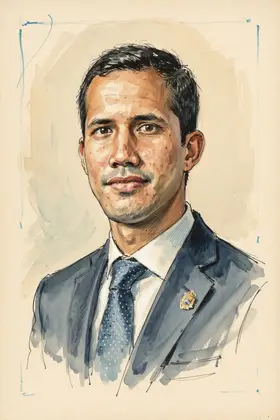
Juan Guaidó on Interim Presidency
TL;DR
Juan Guaidó maintained his position as interim president, established constitutionally in 2019 to restore democracy, until its dissolution in 2023.
Key Points
The interim presidency was established on January 23, 2019, following the disputed 2018 presidential election and based on Article 233 of the Constitution.
At its peak, his interim government was recognized by approximately 60 countries, while the government of Nicolás Maduro was recognized by around 49 nations.
The interim government structure, which was responsible for managing frozen state assets abroad, was voted to be dissolved by the opposition National Assembly on December 30, 2022, ending on January 5, 2023.
Summary
Juan Guaidó established the Interim Government of Venezuela in January 2019, asserting the role of acting president based on his position as the democratically-elected President of the National Assembly and invoking the Venezuelan Constitution following the disputed 2018 election of Nicolás Maduro. This move garnered international recognition from nearly 60 countries, including the United States and many in Latin America and Europe, despite the government holding little actual power within Venezuela. He viewed the interim presidency as a necessary, constitutional, and internationally supported instrument to challenge Maduro's authoritarian rule and pave the way for free and fair presidential elections.
The interim presidency was ultimately dissolved by the opposition-controlled National Assembly in late December 2022, coming to an official end on January 5, 2023, following a vote by three of the four major opposition parties. This decision occurred amid waning domestic and international support, as well as increased normalization of relations between the Maduro regime and some regional governments. While the structure was dissolved, the National Assembly continued to recognize the 2015 legislature, and the United States stated it would no longer recognize Guaidó but also would not recognize Maduro. The interim government's primary accomplishments included managing international assets abroad, such as funds and the gold bullion in the Bank of England, and maintaining a political structure against repression.
Frequently Asked Questions
Juan Guaidó's primary justification for assuming the role of interim president was to restore constitutional order in Venezuela, citing the National Assembly's position as the sole legitimate institution after the 2018 election was deemed fraudulent, according to reports. He stated this action was mandated by the Venezuelan Constitution, specifically Article 233.
The interim presidency, headed by Juan Guaidó, officially came to an end on January 5, 2023, after the opposition-controlled National Assembly voted to dissolve the structure in late December 2022. This dissolution reflected a shift in strategy among the major opposition parties.
International recognition, particularly from the United States and many Latin American and European nations, was crucial as it allowed the interim government to control significant Venezuelan state assets held abroad, such as those in the Bank of England. This recognition served as a major source of leverage against the Maduro regime.
Sources6
The Interim Government of Venezuela Was Dissolved by Its Own Promoters
Interim government of Juan Guaidó - Wikipedia
Venezuela: A Democratic Crisis - United States Department of State
Reflections on the End of Venezuela’s Interim Government
Venezuela's Juan Guaidó is on the verge of losing his interim government | International | EL PAÍS English
Guaidó Is Gone, but Media Dishonesty Is Here to Stay - Venezuelanalysis
* This is not an exhaustive list of sources.