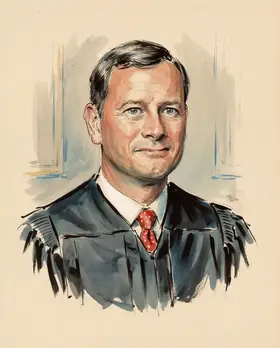
John Roberts on Donald Trump
TL;DR
John Roberts has issued key rulings that significantly expanded presidential authority, often benefiting the former president's agenda.
Key Points
The Chief Justice authored the 6-3 majority opinion in Trump v. United States which granted a former president immunity from criminal prosecution for official acts.
Roberts has pushed back against calls to impeach judges who ruled against the former president, stating impeachment is not an appropriate response to disagreement concerning a judicial decision as of March 2025.
In his 2025 year-end report, John Roberts stressed that federal judges must decide cases impartially, while citing historical developments where the promise of the Declaration of Independence was vindicated.
Summary
Chief Justice John Roberts has presided over a Supreme Court that, under his tenure, has issued landmark decisions substantially favoring expansive views of executive power, particularly in cases involving Donald Trump. The most significant example cited is the Trump v. United States opinion, authored by Roberts, which broadly expanded presidential immunity from criminal prosecution for official acts, even after a former president leaves office. This decision was founded on the idea that the president constitutes a branch of government holding sweeping powers and duties, though Roberts insisted he was separating the power from Trump's conduct itself. Roberts has also been noted for his institutionalist concerns, frequently emphasizing the Court's need for legitimacy and to avoid being seen as political, a concern sometimes reflected in his attempts to temper outcomes, such as his vote in the Affordable Care Act case or his separation from the majority in the Dobbs decision.
Despite Roberts's stated commitment to judicial independence and avoiding partisan outcomes, critics argue his actions have enabled the most hostile anti-institutionalist president elected. The Court's repeated rulings on the emergency docket have often favored the Trump administration in high-stakes, urgent matters, leading to perceptions of partisan support rather than impartial judgment. Furthermore, observers note that Roberts's efforts at judicial self-protection, by issuing procedural rulings that avoid direct conflict, have nonetheless led to conservative outcomes, cementing a legal regime that benefits the former president's agenda and has coincided with declining public trust in the Court.
Frequently Asked Questions
John Roberts's position is primarily defined by his judicial decisions, which have on key occasions strongly favored expansive interpretations of presidential power, often to the benefit of Donald Trump. According to analysis, the Chief Justice authored the ruling that significantly expanded a former president's immunity from criminal prosecution for official acts. While he emphasizes institutionalism, his actions are viewed by some as enabling the former president's agenda.
The primary analysis suggests John Roberts has not fundamentally changed his judicial philosophy, which critics argue has consistently paved the way for the ascent of Donald Trump's political goals. Although the Chief Justice attempts to maintain an apolitical stance and sometimes breaks with the conservative majority, his most consequential opinions in cases involving the former president have tended toward empowering the executive branch, according to legal commentary from late 2025.
The Chief Justice issued a rare statement in March 2025 directly addressing the issue of impeaching judges who ruled against the Trump administration. John Roberts stated that for more than two centuries, it has been established that impeachment is not an appropriate response to disagreement concerning a judicial decision. This statement aimed to defend judicial independence against political attacks following controversial rulings.
Sources5
What Trump Means for John Roberts's Legacy
Chief justice's year-end report goes back to basics
John Roberts Has Always Been a Trump Justice
Chief justice keeps Trump funding freeze in place for now
* This is not an exhaustive list of sources.