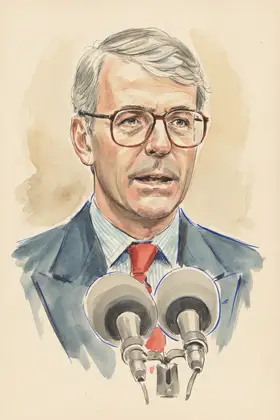
John Major
- Known for
- Prime Minister, Northern Ireland peace process
- Born in
- St Helier, Surrey, United Kingdom
- Education
- Doctor of Laws (LL.D), Queen's University Belfast
John Major served as UK Prime Minister and Conservative Leader from 1990 to 1997, succeeding Margaret Thatcher amidst party turmoil. Known for his mild-mannered and moderate political style, his tenure was defined by significant domestic reforms and high-stakes European negotiations.
Signature Positions
Major's premiership saw decisive action across several key areas:
- Europe/Brexit: Led the UK negotiations for the Maastricht Treaty and famously withdrew the pound sterling from the European Exchange Rate Mechanism (ERM) during Black Wednesday (1992).
- Domestic Policy: Introduced the Citizen's Charter to improve public services and replaced the unpopular Poll Tax with the Council Tax.
- Conflict & Peace: Played a pivotal role in initiating the Northern Ireland peace process and committed British troops to the Gulf War.
- EU Stance: Despite his past involvement in the ERM, he became a vocal supporter of remaining in the EU, strongly criticising Brexit after the 2016 referendum.
How Views Have Evolved
Major's approach to Europe evolved dramatically throughout his career.
Initially pushing for closer integration, he engineered the UK's entry into the ERM in 1990, a move opposed by Thatcher.
However, the political fallout from Black Wednesday and subsequent battles over the Maastricht Treaty fractured the Conservative Party, eventually leading him to adopt a more Euro-sceptic position by the end of his term and later, outright opposition to Brexit.
Notable Tensions
His tenure was marred by internal and external conflicts:
- Internal Party Divisions: His government was constantly undermined by 'Euro-rebels' within the Conservative Party, weakening his authority after the 1992 election.
- 'Back to Basics' Hypocrisy: His socially conservative 'Back to Basics' campaign faced intense scrutiny following the revelation of his own extramarital affair with Edwina Currie.
- Media Hostility: Faced significant criticism, particularly after Black Wednesday, which damaged the Tories' reputation for economic competence, though some journalists later expressed regret over the harshness of the coverage.
Major is often framed in contrast to both Thatcher and his successor, Tony Blair. He is credited by historians with steering the economy out of recession (1990-93) and securing the foundations for Northern Ireland peace.
Despite a record that historians now view more favorably, he remains associated with a period of intense Conservative fragmentation and the beginning of Labour's long run back in power in 1997.