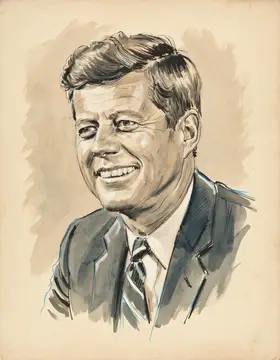
John F. Kennedy on Space Race
TL;DR
John F. Kennedy strongly committed the United States to landing a man on the Moon before the decade concluded.
Key Points
He proposed committing the nation to landing a man on the Moon and returning him safely to Earth before the end of the decade in a message to Congress on May 25, 1961.
The President sought to bolster public support for the effort by famously stating in September 1962 that the goal was chosen because it was hard, not easy.
He instructed Vice President Lyndon Johnson, Chairman of the National Aeronautics and Space Council, to survey where the U.S. could beat the Soviets in space programs in an April 20, 1961 memo.
Summary
John F. Kennedy made the goal of landing a man on the Moon and returning him safely to Earth before the end of the 1960s the top priority for the National Aeronautics and Space Administration (NASA), second only to defense. This ambitious goal, dubbed the “Moonshot,” was set against the backdrop of the Cold War, following significant Soviet achievements like putting the first man into orbit. The President felt a decisive demonstration of American space superiority was politically necessary to counter growing Soviet influence and restore national confidence after early setbacks. He argued that the challenge was hard but essential for organizing the nation's best energies and skills, characterizing space exploration as a new frontier for all people.
This position was first declared to Congress on May 25, 1961, and later reiterated with famous rhetoric at Rice University in September 1962, where he framed the endeavor as a deliberate choice by a free people. Although the massive expenditures required caused some public and congressional disquiet, his firm commitment drove the expansion of NASA and the focus of the Apollo program. He even explored the idea of a joint mission with the Soviet Union early on, but this proposal was ultimately declined. The commitment to this singular goal persisted throughout his administration, solidifying the Moonshot as a defining legacy of his presidency, which was realized posthumously.
Key Quotes
... it will not be one man going to the moon—if we make this judgment affirmatively, it will be an entire nation. For all of us must work to put him there.
Frequently Asked Questions
John F. Kennedy's primary objective for the Space Race was to commit the United States to successfully landing an astronaut on the Moon and ensuring his safe return before the conclusion of the decade, according to his 1961 address to Congress. He viewed this as an essential national endeavor that would demonstrate American technological superiority over the Soviet Union. The President remained firm on this singular focus throughout his term.
Yes, John F. Kennedy proposed the idea of a joint expedition to the Moon when he met with the Soviet Premier in June 1961, as documented by historical records. While the exact motivation is debated, it may have been an attempt to lower Cold War tensions or compensate for the perceived American technological lag. The Soviet leader ultimately declined the offer, and the concept was not pursued further by subsequent administrations after Kennedy’s death.
The urgent push for the Moon landing was primarily driven by the Cold War context, as the Soviet Union had achieved several significant early space 'firsts,' which embarrassed the United States, according to historical accounts. Kennedy believed a dramatic achievement was necessary to demonstrate America's preeminence in space technology and influence the minds of uncommitted nations. He made it clear that failure to pursue this goal decisively would result in the U.S. falling behind.
Sources6
JFK and the Space Race | Miller Center
We choose to go to the Moon - Wikipedia
President John F. Kennedy and the Moonshot: Inspiration and Achievement
Memo from President John F. Kennedy to Vice President Lyndon Johnson, April 20, 1961 | U.S. Capitol - Visitor Center
The Decision to Go to the Moon: President John F. Kennedy's May 25, 1961 Speech before a Joint Session of Congress - NASA
What Was the Space Race? | National Air and Space Museum
* This is not an exhaustive list of sources.